



Iseki TK troubleshooting: won’t start, lift not working & more
Iseki TK not starting? Lift not working? Engine overheating? In this troubleshooting guide we go through all the common problems of the Iseki TK series, with the likely cause, where the problem is located, and what to do about it for each complaint. The basis comes from the official troubleshooting tables in the Iseki manuals, supplemented with what owners of this series encounter in practice.
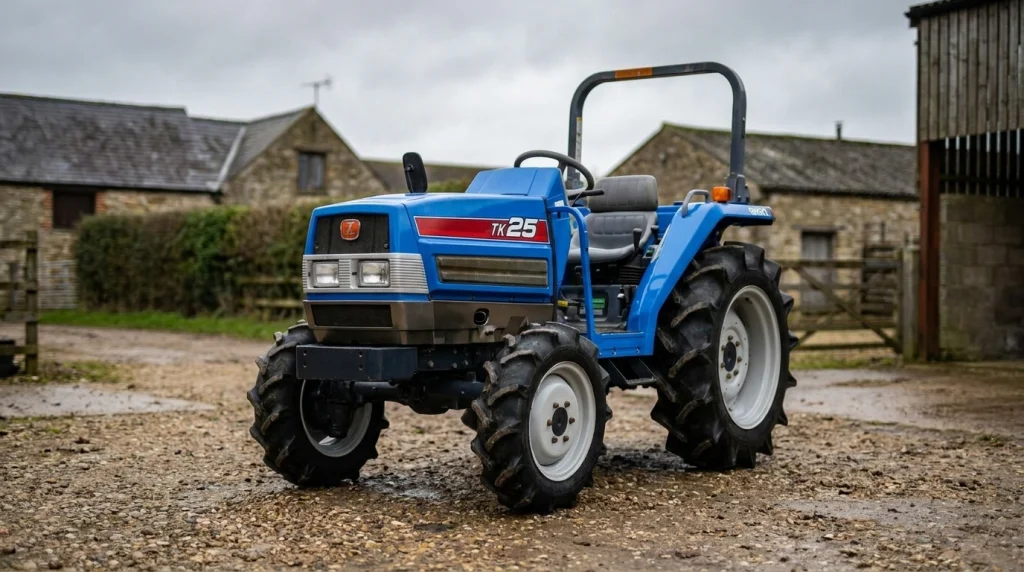
Suitable for the entire series: Iseki TK21, TK25, TK29, TK33 (Japanese) and Iseki TK527, TK532, TK538 (European). This largely also applies to the Massey Ferguson sister models with the same Iseki E3 engines.
Iseki TK won't start: starter motor doesn't turn
- Clutch pedal not (fully) depressed. The starter safety switch on the clutch pedal otherwise blocks the starter motor. This is cause number one — press the pedal all the way down. If that doesn't work, the safety switch itself may be defective or misaligned (located at the top of the pedal).
- Battery flat or weak. Charge the battery (12V 55Ah) or replace it. Also check the acid level.
- Transition resistance in cables and ignition switch. A classic issue in practice at this age: corroded battery terminals, a tired earth strap, or a worn ignition switch only let 9–10 volts reach the starter motor. Clean the terminals and earth points and measure the voltage on site.
- Starter motor or solenoid switch defective. If you only hear a click, gently tap the starter motor and try again; if it keeps clicking, then a replacement starter motor (SKU-129010) is the solution.
Iseki TK won't start: starter motor does turn
- Glow plug system. Especially below 10°C: if the glow indicator light goes out too quickly or doesn't glow at all, check the glow plugs (SKU-55001) (located at the front of the cylinder head) and the glow plug relay. One defective glow plug already makes cold starting noticeably harder.
- Air in the fuel system. After running dry or replacing the filter: bleed at the fuel filter and pump. Symptom: engine starts briefly and stalls, or won't catch at all.
- Fuel filter clogged or valve closed. Check the sediment bowl and replace the filter element (SKU-150003).
- Stop solenoid or stop control stuck in stop position. The fuel shut-off valve on the injection pump must release when the ignition is switched "on". A sticking solenoid or damaged wiring is a notorious hidden cause in practice: the engine then does literally nothing, no matter how well it cranks. Recognizable by: no click from the solenoid when switching ignition on/off.
Iseki TK runs erratically or stalls
- Air in the fuel or leaking lines. Check clamps and lines between the tank, filter, and pump; bleed the system. Lightly sand and re-lap the copper rings of the line couplings, as the manual states.
- Clogged injectors or uneven injection. An engine that knocks, smokes, or runs on two cylinders often needs a round of new injectors. For the naturally aspirated engines use injector E3CD/E3CE/E3CF (SKU-47012-s), for the TK538 turbo the different injector E3CD-T (SKU-47037-s).
- Engine stalls at idle. Idle speed set too low, valve clearance, or a tired injection pump — adjustment work for the workshop. You can find idle reference values in the specifications blog.
Iseki TK overheats (overheating)
- Water pump worn. The well-known cooling problem in practice with this engine family: bearing play or leakage from the weep hole under the pump. Replace preventively with the water pump Iseki TK (SKU-320).
- Coolant level too low / radiator dirty. Top up, remove chaff and dirt between the cooling fins, and keep the front screen clean.
- Fan belt slipping. Check tension: 10–12 mm deflection; too loose means poor cooling and poor battery charging.
- Aging radiator cap. A cap that doesn't hold pressure causes the system to boil prematurely — replacing it (SKU-3240) only costs a tenner.
Iseki TK smokes white or black
White smoke: clogged air filter, too much engine oil, or too little fuel supply; persistent white smoke with coolant loss points to the head gasket (for E3CF: SKU-65102, for E3CD/E3CE: SKU-72 — pay attention to the engine code, the gaskets differ per bore!). Black smoke: dirty air filter, overloading, or too much/poor fuel. First replacing the air filter (SKU-20008) is the cheapest diagnosis.
Iseki TK oil pressure or charge warning light comes on while driving
Oil pressure warning light: stop immediately. Causes according to the manual: oil level too low, wrong (too thin) oil, clogged oil filter, defective pressure switch, or oil pump. Charge warning light: loose or corroded wiring, slipping fan belt, defective alternator or regulator, or a battery reaching the end of its life. A suitable alternator (SKU-120002) and starter motor are supplied based on the engine code; if in doubt, email us the type plate.
Iseki TK clutch slips or doesn't disengage
- Slipping: free play too small (should be 20–30 mm) or worn/glazed lining. Not disengaging: free play too large, or the plate has rusted onto the flywheel after long storage (can sometimes be freed by starting with the clutch pedal depressed — do this carefully, in an open area).
- Parts by model: TK21/TK25 and TK527/TK532 have the 225 mm clutch — clutch plate (SKU-3018418-2), pressure plate assembly (SKU-75030) and thrust bearing (SKU-70003). The TK538 has a larger 240 mm clutch and the TK546 260 mm — order these by serial number, and we'll find the correct size for you.
Iseki TK lift not working or slow
The classic issue of this series. Work through the list from cheapest to most expensive:
- Engine speed. The pump only delivers sufficient oil from around 1000–1500 rpm; lifting at idle is slow, which is normal.
- Drop speed knob. If it's turned closed, the lift won't lower — not a fault, just open it up.
- Oil level and oil type. Too little or too thick (cold) transmission oil = slow lift and a whining pump. See engine oil & fluids.
- Suction filter and hydraulic filter dirty. By far the most commonly found cause in practice: clean the suction strainer and replace the filter cartridge (see filters blog).
- Air in the suction line. A dried-out O-ring or cracked suction hose lets the pump take in air: foaming oil and a jittery, weak lift. Retighten clamps, replace O-rings.
- Pump, control valve, or cylinder. If pressure remains absent (the relief valve should only release at 150 bar), it's a job for the workshop: pump wear, control valve, or cylinder.
If a whistling bypass sound occurs as soon as you set the lever to "lift", the lever stop is incorrectly adjusted — the manual also describes this as an adjustment point.
Iseki TK pulls to one side when braking or steers heavily
Braking to one side: unequal free play left/right (30–40 mm, adjust equally) or worn linings. Heavy or jittery steering: unequal tire pressure left/right, toe-in misaligned (2–6 mm), play in the steering ball joints, or power steering with too little oil or a full filter. Rattling front axle: adjust longitudinal play (0.1–0.3 mm) and grease the central pivot.
Iseki TK front axle leaks oil
Oil loss at the swivels of the driven front axle indicates worn seals — a known wear point of this Iseki generation, often accelerated by wire remnants and rope around the swivel axle. Replace in time, otherwise the axle will run dry: front axle seal vertical TK21–TK538 (SKU-96065) or front axle seal (SKU-96014). Leakage behind the crankshaft or at the flywheel: crankshaft seal (SKU-96087).
Iseki TK: engine internals
In case of power loss with blue smoke and oil consumption, pistons, rings, and bearings come into play. Everything is available by engine code: pistons E3CD/E3CD-T (SKU-100052), pistons E3CF (SKU-100054), main bearing set E3CD (SKU-110025), valves (SKU-97104) and even a complete cylinder head E3CD/E3CE/E3CF (VAR-0144). Again: E3CF (86 mm) and E3CD (87 mm) are not interchangeable, and the turbo has partly its own parts — order by engine code and serial number.