



Iseki TK starting & operation: pre-glowing, warming up and driving
Starting and operating an Iseki TK is not difficult, but the manual contains a number of rules that make the difference between a long and a short engine life. In this blog: the complete starting procedure, the official pre-glow and warm-up times per outside temperature, the operation of the 16-speed gearbox and the safe stopping procedure.
Suitable for the entire series: Iseki TK21, TK25, TK29, TK33 (Japanese) and Iseki TK527, TK532, TK538 (European).
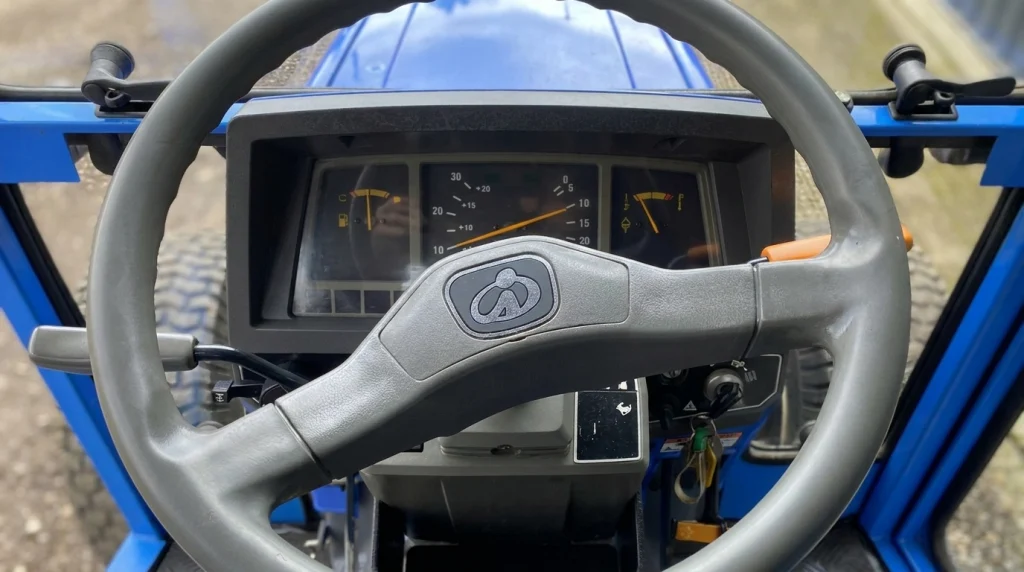
Iseki TK dashboard and warning lights
When you turn the key to the drive position, three lights should come on: the oil pressure light, the charging current light and the pre-glow light. After starting, the oil pressure and charging current lights should go out immediately — if one stays on, switch off the engine and find the cause (see Troubleshooting Iseki TK faults). You'll also find the hour meter on the dashboard (the basis of your maintenance schedule), the fuel gauge and the temperature gauge.
Starting the Iseki TK: the procedure step by step
- Sit in the seat and check that the parking brake is engaged.
- Lower an attached implement to the ground using the lift lever.
- Press the clutch pedal fully in — the TK has a starter safety switch: without the clutch pressed in, the starter motor won't turn.
- Put the main gear lever, the range lever and the PTO lever in neutral (versions with a PTO switch: switch off, light out).
- Set the hand throttle to about halfway.
- Turn the key to the glow position; wait until the pre-glow light goes out.
- Turn further to the start position and release the key as soon as the engine runs.
- Check that the oil pressure and charging current lights have gone out.
Two hard rules from the manual: run the starter motor for a maximum of 10 seconds and then wait at least 10 seconds before a new attempt, and never turn the key back to the start position while the engine is already running. If the engine still won't start after a few glow cycles, don't keep trying endlessly — worn glow plugs (SKU-55001) or air in the fuel are the usual causes.
Warming up the Iseki TK: more important than you think
After starting, Iseki prescribes warming up at approximately 1500 rpm. The official table:
| Outside temperature | Warm-up time |
|---|---|
| Above 0 °C | 5–10 minutes |
| 0 to −10 °C | 10–20 minutes |
| −10 to −20 °C | 20–30 minutes |
| Below −20 °C | At least 30 minutes |
Why so strict? Because the hydraulic pump draws its oil from the transmission: cold, thick oil is poorly drawn in, which can cause the pump to whine and eventually get damaged. Driving off cold right away and lifting heavy loads is therefore the fastest way to create hydraulic problems. Apply the parking brake while warming up.
Shifting the Iseki TK: finding your way around 16 gears
The TK combines a main gear lever (1–4, synchronized) with a range lever (creep – low – mid – high) and a shuttle lever for forward/reverse. Rule of thumb per job: milling and digging in the creep or low range, loading and field work in the mid range, transport in the high range. Only shift the range lever when stationary; shift the main gears with the clutch engaged. European models with power shuttle reverse without a clutch pedal — briefly easing off the throttle makes the reversal smoother. Differential lock: only engage when driving straight ahead on slippery ground, never in a turn.
Stopping and parking the Iseki TK
- Reduce throttle and bring the tractor to a stop; after heavy work, let the engine idle for another 5–10 minutes (especially the TK538: a hot turbo needs to cool down after use).
- Switch off the engine with the key — never switch off directly from high revs.
- Apply the parking brake, lower the implement to the ground, remove the key.
If the engine doesn't switch off with the key (faulty stop control), according to the manual you can stop it manually via the stop lever on the fuel pump behind the side panel. Have the cause repaired afterwards.
Working safely with the Iseki TK: the most important rules
Never start while standing next to the machine or with a bridged starter motor — the starter safety switch is there for a reason. Drive up and down slopes straight on, don't disengage the clutch on slopes, and use the lift lock when transporting implements. Don't take passengers and never let the engine run in an enclosed space. When leaving the tractor: lower the implement, apply the parking brake, switch off the engine, remove the key.
Product tip: for a smooth start
- Glow plug Iseki TK / E3CD (SKU-55001) — the solution for difficult cold starting.
- Starter motor Iseki (SKU-129010) — for TK models with E3 engine.
- Fuel filter Iseki (SKU-150003) — a clean filter prevents stalling and air problems.