




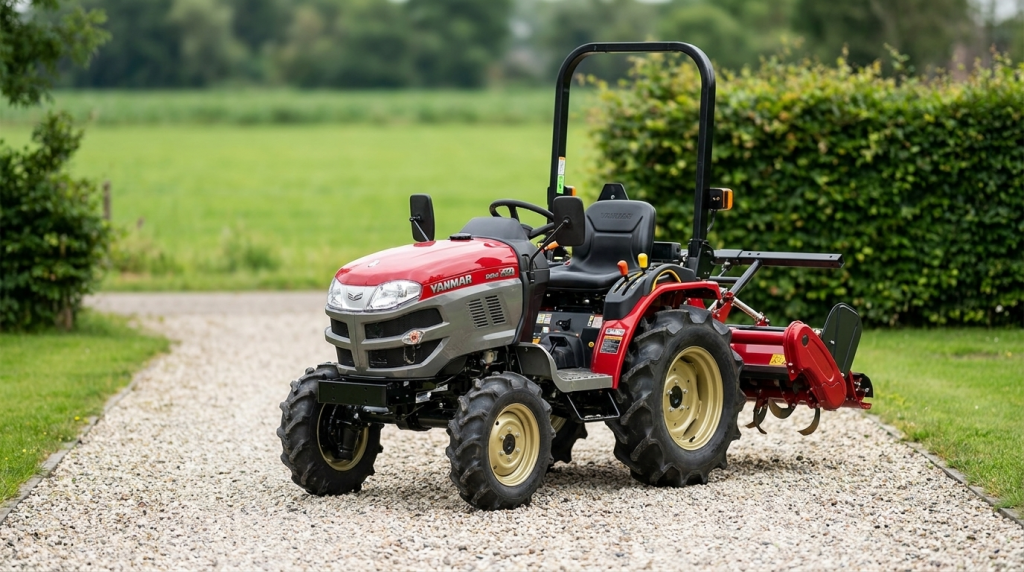
Buying a Yanmar GK13–GK18: purchase advice for the Ecotra GK series
Considering buying a Yanmar GK13, GK14, GK16 or GK18? This Ecotra GK series is one of the most modern compact tractor series you'll come across as a (grey) import from Japan, and it was also officially supplied in Europe as the Yanmar GK160 and GK200. In this buying guide you'll read how the models differ from one another, what to look out for during a viewing, and how parts availability works.
Suitable for the entire series: Yanmar GK13, GK14, GK16 and GK18 (Ecotra), plus the European versions GK160 and GK200(R).
Yanmar GK series: the younger sibling in Yanmar's lineup
The GK series ("Ecotra") is Yanmar's most compact tractor line and is significantly younger than the well-known F, FX and AF series: the manual for this series dates from 2014, and the European introduction of the GK160 followed around 2015 (indicative, external source). So you don't get 1980s technology but a modern machine with fully hydraulic power steering, a reverse lever next to the steering wheel (forward/reverse without extra shifting), engageable/disengageable 4WD and an adjustable safety bar. The engines come from Yanmar's TNV family with indirect injection: quiet, economical and virtually indestructible with proper maintenance.
Yanmar GK13, GK14, GK16 and GK18: the differences
The series has four power classes with two different engines. That distinction is more important than it seems, because bore and displacement differ — and so do engine components such as gaskets and piston rings.
| Model | Engine | Displacement | Power | EU name |
|---|---|---|---|---|
| GK13 | Yanmar 3TNV70 | 853 cc | 13 hp / 2400 rpm | — |
| GK14 | Yanmar 3TNV70 | 853 cc | 14.5 hp / 2400 rpm | GK160 (15.1 hp ECE-R24) |
| GK16 | Yanmar 3TNV76 | 1115 cc | 16.5 hp / 2300 rpm | — |
| GK18 | Yanmar 3TNV76 | 1115 cc | 18.5 hp / 2400 rpm | GK200(R) (19.3 hp ECE-R24) |
The GK13 and GK14 share the 3-cylinder 3TNV70 with a 70 mm bore; the GK16 and GK18 have the larger 3TNV76 with a 76 mm bore. As a result, cylinder head gaskets, piston rings and other engine parts are not interchangeable between the two groups. The filters (oil, fuel, air), on the other hand, are the same across the entire series — which makes maintenance nice and straightforward.
Yanmar GK variants: watch out for the letter code
Behind the model number is a variant code, and this determines the dimensions. There's a narrow S version (885 mm wide), a low F version (1765 mm high, smaller wheels — handy for orchards or greenhouses), loader-prepared M/OM versions, and the U version with Yanmar's UFO lift automation, which automatically keeps the implement level and at the correct depth. So a GK16 U is fundamentally differently equipped than a GK16 S. When buying, always check the type plate for the model and variant code, and note the engine number (3TNV70 or 3TNV76).
Buying a Yanmar GK: what to check during a viewing
Start the engine cold: after the glow plug indicator light goes out, it should start promptly without prolonged white smoke. Check the clutch pedal play (15–25 mm is factory spec) and whether the tractor shifts smoothly through all 8 forward and 4 reverse gears. Test the hydraulics: the lift should be able to raise 550 kg at the ball links and not drop when the engine is stopped. On a U version: test the UFO automation and the associated switches — repairing electronics is trickier than mechanical work. Also check the condition of the water separator (rust or water in the glass indicates a neglected fuel system), the V-belt and the radiator screen. Under 2000 operating hours is still modest for this series; with proper maintenance, the engine will last many times that.
Yanmar GK160 and GK200: official import versus grey import
If your machine comes from the official European channel (GK160/GK200), it usually has EU lighting, a tow hitch and cat. 1N lift arms. Japanese grey imports (GK13–GK18) may differ in lighting and configuration, but are largely technically identical — the parts from our shop fit both. Always mention your type plate details when ordering, so we can check the fit per serial number.
Get your maintenance sorted right away: with the filter set for the Yanmar GK series (SKU-100114) you replace the oil filter, fuel filter and air filter in one go — the OEM numbers match exactly with the factory manual for the GK13–GK18. Combine with coolant down to -40 °C (SKU-125001) for a complete major service after purchase.
Yanmar GK13–GK18: parts well available
Because the GK series is built on the widely used TNV engine family, availability of wear parts is excellent: filters, water pumps, starter motors, alternators and glow plugs are all available from stock. We're also here for you for bigger engine work: for the 3TNV70 (GK13/GK14) we supply the cylinder head gasket (SKU-65105), the complete gasket set (SKU-80107) and even a complete cylinder head set (SKU-990032); for the 3TNV76 (GK16/GK18) there's a cylinder head set including gasket set and thermostat (SKU-990033). Also check out our knowledge base on the Yanmar 3TNV70/3TNV76 engines for more in-depth engine information.