



What Can You Do With the Kubota Aste A-155, A-175 and A-195? – Implements and Applications
What Can You Do With the Kubota Aste? Implements and Applications for the A-155, A-175 and A-195
You have a Kubota Aste — or you're considering buying one — and you're wondering what you can actually do with it. Will a standard rotary tiller fit? Can it pull a plough? What about a front loader? In this guide I'll cover everything the A-155, A-175 and A-195 are technically capable of: from PTO specifications to concrete implement recommendations per engine power.
Quick summary: the Aste is a 16, 17.5 or 19 hp compact 4WD mini tractor with a JIS Category 0 three-point linkage, a JIS 35 mm PTO with four speeds (450, 795, 1187 rpm forward + 612 rpm reverse) and a lift capacity that's more than sufficient for implements up to about 1.5 m working width. Good for all light to medium soil cultivation, less suitable for heavy ploughs or front loaders.
PTO specifications: four settings for every job
The PTO (power take-off) on the Aste is the power source for all your driven implements: tiller, mower, snow blower, pumps. Kubota fitted four settings here, letting you choose the right speed per implement.
| PTO setting | Speed (rpm) | What is it used for? |
|---|---|---|
| 1 | 450 | Slow, heavy implements — heavy soil cultivation, pumps |
| 2 | 795 | Standard soil tilling in normal ground |
| 3 | 1187 | Fine tilling, mowing, mulching |
| Reverse | 612 | Reverse tilling (for reverse-rotary tillers) |
These values apply at the nominal engine speed of 2650 rpm. On the V-Shift (F) version (A-175F, A-195F), the figures differ slightly: 451, 769, 1171 and 564 (reverse) rpm.
Spline size: JIS 35 mm
The PTO shaft has a JIS 35 mm spline (equivalent to the international ASAE 1⅜" 6-spline standard). This is the most common size among Japanese mini tractors — so you can use by far most universal implements and adapters without any hassle.
No live PTO!
Important to know: the Aste does not have a live PTO. This means that when you press the main clutch (for example, to shift gears), the PTO also stops. With heavily driven implements such as a mower or tiller, this can cause shock loading at the moment of engagement or disengagement.
Three-point linkage: JIS Category 0
The Aste has a three-point linkage in JIS Category 0. This is a more compact size than the international Cat 1, and you do need to take this into account when purchasing implements:
| Category | Lower link pin | Top link pin | Typical for |
|---|---|---|---|
| JIS Cat 0 | 17 mm | 19 mm | Japanese mini tractors (Kubota Aste, Iseki TU/TF) |
| Cat 1 (international) | 22 mm | 19 mm | Larger compact tractors (from approx. 25 hp) |
Many Dutch horticultural implements are built to Cat 1 as standard. These don't fit directly on the Aste — you'll need reducer bushings or an adapter kit. Preferably choose Japanese implements or ones specifically built for Cat 0.
The control is position control: you set the height in advance with the lever and the lift moves to that position. On the MA version (Monroematic Auto), the lift works automatically with depth control via a sensor on the tiller.
Which implements fit the Kubota Aste?
Below, per implement, what's realistic for the A-155, A-175 and A-195. I'll go through each implement type and indicate specifically which model can handle it.
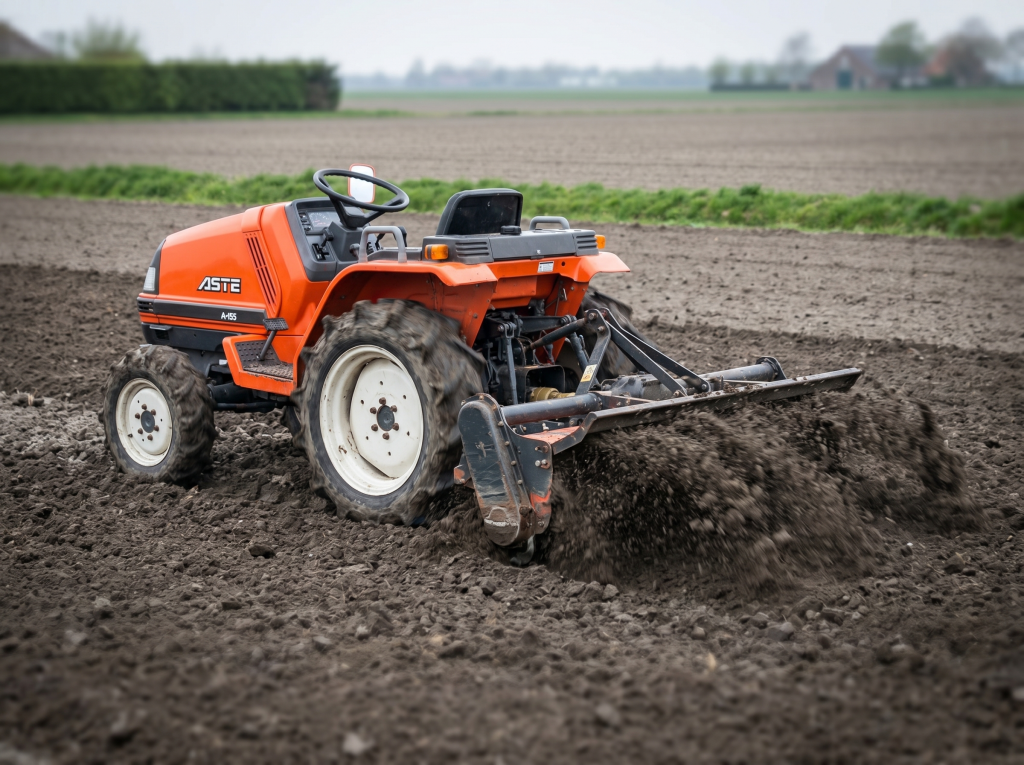
Rotary tiller / soil tiller
The classic for the Aste. Kubota often supplied the tractor in combination with an RSP or RKP tiller. From the original Kubota specifications:
| Tiller | Type | Working width | A-155 | A-175 | A-195 |
|---|---|---|---|---|---|
| RSP105 | Side-drive | 1000 mm | ✅ | ✅ | — |
| RSP115 | Side-drive | 1100 mm | ✅ | ✅ | ✅ |
| RSP125 | Side-drive | 1200 mm | ✅ | ✅ | ✅ |
| RSP135 | Side-drive | 1300 mm | ✅ | ✅ | ✅ |
| RSP155 | Side-drive | 1500 mm | — | ✅ | ✅ |
| RSP165 | Side-drive | 1600 mm | — | ✅ | ✅ |
| RKP105 | Centre-drive | 990 mm | ✅ | ✅ | ✅ |
| RKP125 | Centre-drive | 1230 mm | ✅ | ✅ | ✅ |
Standard tilling depth is 12 cm, working speed 0.9–4.5 km/h. With a universal (non-Kubota) tiller you can go up to about 1.4 m working width on an A-155 or A-175, and 1.5–1.6 m on an A-195. Note that the tiller must have a JIS 35 mm PTO connection and that the three-point linkage attachments must fit Cat 0.
Ridger / hilling plough
For ridge cultivation (potatoes, asparagus, onions), Kubota supplies three standard ridger sizes that fit all Aste models:
- No. 4 ridger: 12 cm furrow width, 85.4 cm blade length
- No. 5 ridger: 15 cm furrow width, 86.5 cm blade length
- No. 7 ridger: 21 cm furrow width, 92 cm blade length
The ridger is mounted on a separate ridger bracket behind the tiller, or directly on the three-point linkage as a standalone implement.
Pull-type plough
A single-share plough is feasible on all three Aste models in light to medium soil (sand, loam, light clay). A 2-share plough is too heavy — even for the A-195. Tips:
- Always engage 4WD when ploughing
- Use front ballast weight (more on this below)
- Work in a low gear, 1st main + low range
- In heavy clay: consider a professional tractor from 25 hp upwards
Mowers
Rotary and flail mowers up to 1.4 m working width fit all Aste models. On the A-155 (16 hp), 1.2 m is more practical — otherwise engine speed drops too much in tall grass. For heavy flail work (thick shoots, willow regrowth), the A-195 is clearly the best choice.
Snow blade and snow blower
A snow blade behind the tractor fits fine on all models. A driven snow blower with a maximum working width of 1.2 m is feasible on the A-175 and A-195 — the A-155 really doesn't have enough hp for this if there's heavy, wet snow.
Front loader — is that possible?
This is a frequently asked question and the honest answer is: not really. Kubota did not supply the Aste with front loader provisions from the factory. A front loader fitted afterwards is technically possible, but the chassis and front axle are not designed for that extra load. In practice you rarely see this — if you really want a front loader on a compact tractor, it's better to look at the newer Kubota B series (B1700, B2150, etc.) with factory-fitted front loader brackets.
Transport and trailer
For transport work around the yard, the Aste is excellent — all models have a tow hitch under the rear. Expect around 500–1000 kg of load when driving calmly on flat ground. For use on public roads, the tractor is legally classified as an agricultural vehicle; check with the RDW for current registration and insurance requirements in the Netherlands.
HP versus weight: the practice
The rated power of a tractor doesn't tell the whole story. Weight, grip and ballast distribution determine what it can truly handle.
A-155 (16 hp, 665 kg)
The lightest of the three. Ideal for gardens, nurseries, small plots up to approx. 1 ha. Heavy ploughing and tilling in clay is at the limit. Plus: more fuel-efficient, more manoeuvrable in tight spaces.
A-175 (17.5 hp, 685 kg)
The mid-range model with the best price-performance ratio. Pulls a tiller up to 1.3 m effortlessly, mulches regrowth without issues. The most popular choice on the used market and therefore often also the most tradeable.
A-195 (19 hp, 695 kg)
The strongest. Handles heavier implements and larger working widths. If you regularly work in clay or on slopes, or want to run a 1.5 m tiller: choose the A-195.
Tips if your tractor feels "too light"
- Ballast weight front or rear: Kubota supplied a 25 kg front weight as standard, with a 40 kg bumper weight as an option. This helps with tilling and ploughing work.
- Always engage 4WD on heavy soil. The Aste has four-wheel drive as standard — use it.
- Check tyre pressure: lower pressure increases the contact surface and therefore traction. Rear 1.6 kgf/cm² (standard), front 1.2–2.0 kgf/cm².
- Choose a low gear: 1st main + low range = plenty of pulling power, low speed. Perfect for heavy work.
Frequently asked questions
Can I fit universal Cat 1 implements on my Aste?
Only with reducer bushings or a Cat 0 → Cat 1 adapter kit. Not ideal — the Aste is not built to mechanically carry Cat 1 implements properly. Preferably choose JIS Cat 0 implements.
How much can the Aste tow?
Kubota does not provide official towing figures in the manual. In practice, an Aste handles 500–1000 kg of trailer load on flat terrain without difficulty. More than 1,500 kg is not recommended without a support wheel, especially not on a slope or uneven terrain.
Will a standard Dutch tiller fit my Aste?
Yes, provided: (1) working width no greater than 1.4–1.6 m depending on the model, (2) PTO connection JIS 35 mm / 1⅜" 6-spline, (3) required drive power ≤ 19 hp, and (4) three-point linkage suitable for Cat 0 (or an adapter available).
Which PTO setting should I use for my tiller?
For most soil tillers: PTO setting 2 (795 rpm) or 3 (1187 rpm). Setting 2 for heavier soil, setting 3 for normal soil and finer cultivation. Start with setting 2 and shift up if the speed stays well maintained.
Can I use a reverse-rotary tiller (tilling backwards)?
Yes — the Aste has a separate PTO reverse setting (612 rpm). Useful for slopes where you can't turn around, or for fine re-tilling. On the MA version, the automatic depth control also works in reverse.
In summary: what is the Aste good for?
In short: the Kubota Aste is an excellent all-rounder for compact to medium-sized jobs — garden maintenance, soil cultivation on small plots, ridge cultivation, mowing, snow clearing, transport around the yard. It is not suitable for: front loader work, heavy ploughing, or pulling large agricultural trailers. For everything below that, it's ideal.
The choice between the A-155, A-175 and A-195 mainly comes down to working width and soil weight. Do you have light soil and mostly garden work? The A-155 is fine. Clay or larger implements? The A-195 is worth the extra cost.