



What can you do with the Iseki SIAL TF15, TF17 and TF19? – Implements and applications
The Iseki SIAL series is built as a compact all-rounder. With 15.5 to 19 HP, a three-position PTO and a JIS 0-category 3-point linkage, it can carry surprisingly many implements. But what can this tractor really handle, and where are the limits? In this article we discuss the possibilities per implement type.
PTO specifications: three positions for every implement
The PTO shaft (power take-off) of the SIAL series has three speed positions that you select with a lever. You must press the clutch pedal before shifting the PTO lever.
| PTO position | Use | Speed (rpm) |
|---|---|---|
| 1 | Heavy work — uprooting, heavy tilling | 524 / 522* |
| 2 | Normal ploughing and tilling | 730 / 728* |
| 3 | Fine tilling and mowing work | 1187 / 1183* |
* Values in brackets apply to the G version (linear shift). The Z version additionally has reversed PTO positions: 540, 753 and 1224 rpm.
The PTO shaft has a 6-spline connection with a 35mm diameter. This is a JIS standard that fits most Japanese and universal implements. Note: some European implements use a 6-spline at 540 rpm — always check that the speed matches what the implement requires.
Tractors with the Z version have a reverse switch that allows the PTO shaft to also rotate in the opposite direction. This is useful for earthmoving and pushing soil at the edges of a plot. Note: never use the reverse switch at high speed and never on untilled land.
3-point linkage
The SIAL series has a JIS 0-type 3-point linkage with position control. With the WX version you also get electronic depth control and horizontal levelling control — a major difference in ease of use.
Operation is simple: move the lift lever (control lever) backwards to raise the implement, and forwards to lower it. Use the stopper to set the maximum height and depth. The lowering speed is adjusted separately with a dial under the seat.
Important: When changing implements, always set the lowering speed control to "lock". Otherwise the implement can drop unexpectedly — extremely dangerous.
Which implements fit the Iseki SIAL?
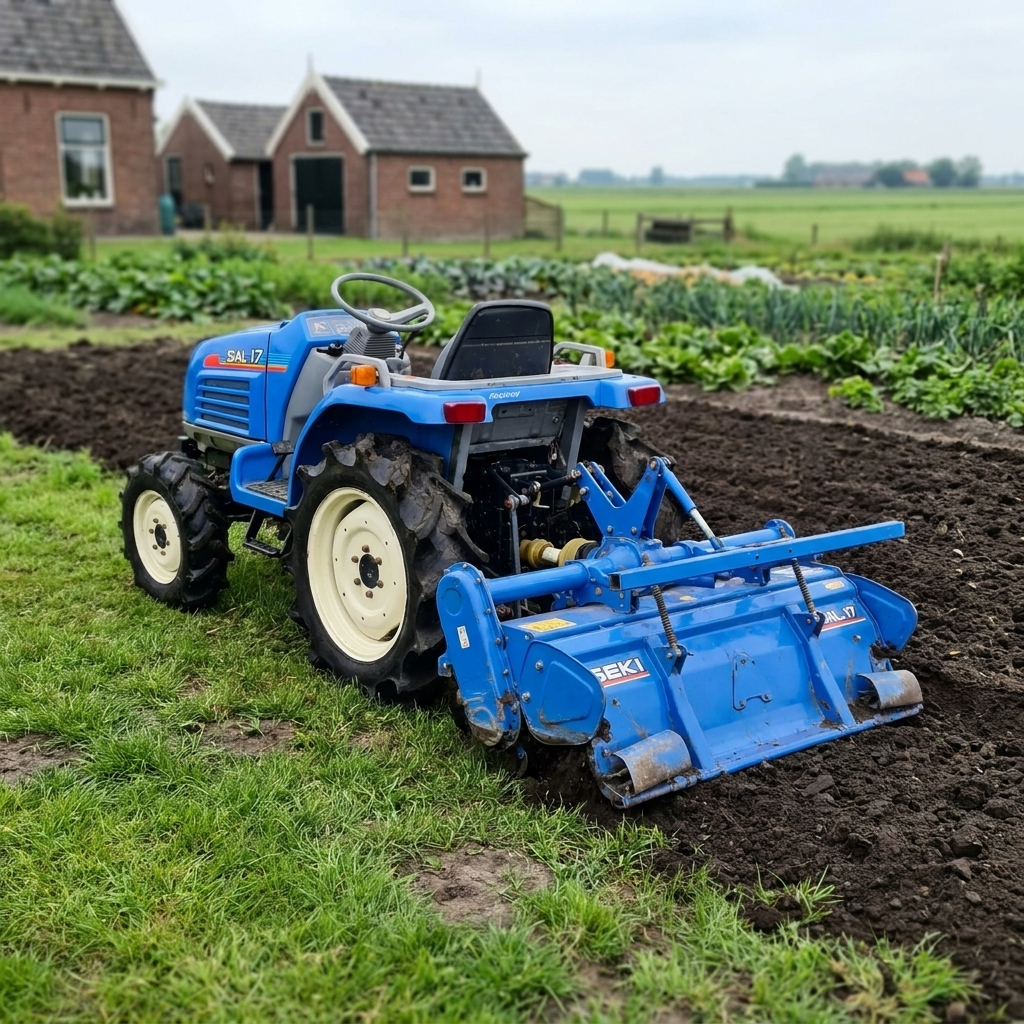
Rotary tiller / soil tiller
This is what the SIAL series was made for. A rotary tiller of 100-120cm wide fits perfectly on the TF17 and TF19. The TF15 can reliably drive a tiller up to 100cm at most. Use PTO position 2 or 3, depending on the soil type. For heavy clay: position 2 with a low driving speed and 4WD engaged.
Flail mower
A flail mower of 100-120cm works well. Make sure you run PTO position 3 for sufficient blade speed. The TF15 is the least comfortable here — with tall grass you'll notice the lack of power.
Rotary/disc mower
A drum or disc mower of 120-150cm fits, provided it's a light model. Watch the weight: the tractor itself only weighs 700-735 kg, so a mower that's too heavy will disturb the balance.
Plough
A single-furrow plough up to 25cm wide works with the TF19. The TF17 can manage it too, but don't expect speed. The TF15 is actually too light for ploughing in anything other than light sandy soil. Always use 4WD and a low gear when ploughing.
Snow blower / snow plough
A snow plough of 100-120cm is no problem. A snow blower is also possible, but pay attention to the required PTO speed. Most snow blowers require 540 rpm — PTO position 2 (730 rpm) is then slightly too high. Check the implement's specifications.
Front loader
A light front loader (up to approximately 150 kg lift capacity) is possible, but be careful: the maximum front weight is only 45 kg on the HJ version. Front loader work is discouraged by the manufacturer due to front axle loading. On the standard version it's even tighter. If you use a front loader, a counterweight at the rear is essential.
HP versus weight — in practice
The SIAL series weighs between 670 and 815 kg (depending on model and version). That's relatively light. With heavy draft work — think ploughing, pulling a full trailer or working on wet clay soil — you'll notice the weight falling short. Tips to get the most out of your tractor:
Always engage 4WD for soil cultivation. The difference in traction is enormous.
Use the lowest gear that allows the work to be done. Slow and steady is better than fast with stalling.
Ballast weight. Rear wheel weights or a front weight help with traction. Iseki specifies a maximum front weight of 45 kg.
Be realistic. If the engine noticeably drops in speed while tilling, you're going too deep or too fast. Raise the tiller slightly or reduce the driving speed.
Frequently asked questions
"Can I fit a front loader on it?"
Technically it's possible with an aftermarket front loader, but Iseki advises against it due to the limited front axle loading. If you do it anyway, use a light model and always a counterweight at the back.
"Does a standard European tiller fit?"
The 3-point linkage is JIS 0-type, which is comparable in dimensions to category I but not identical. Most Japanese tillers fit directly. European implements usually fit too, but check the pin diameter and the distance between the lower link points.
"How much can it pull?"
There's no officially stated pulling capacity, but in practice a TF19 with 4WD can comfortably pull a small trailer of 500-800 kg on flat terrain. For heavy pulling work (trailers, tree stumps), this tractor class is not suitable.
Need parts for your Iseki SIAL?
Shop4trac supplies filters, gaskets, clutch kits and more — fast delivery from the Netherlands.