



Solving Iseki TX1410 & TX1510 Problems and Faults
Solving Iseki TX1410 & TX1510 problems
Does your Iseki TX1410 or TX1510 start poorly, overheat, or does the lift not lower? In this troubleshooting guide we go through the most common problems — with the likely cause and solution for each complaint. The diagnoses come from the fault tables in the original Iseki manual, supplemented with practical experience from owners.
Suitable for the entire series: TX1410, TX1410F (4WD), TX1510 and TX1510F (4WD). Many complaints also apply to related TX models and the Bolens rebadges.
Engine won't start or starts poorly
| Symptom | Likely cause | Solution |
|---|---|---|
| Starter motor doesn't turn | Clutch pedal not depressed | Fully depress the clutch |
| Starter motor doesn't turn | Battery flat or loose terminals | Charge the battery, clean and tighten the terminals |
| Starter motor turns slowly | Weak battery, poor earth connection, oil too thick | Charge, clean the earth connection, use correct oil viscosity |
| Starter motor turns, engine doesn't start | Air in the fuel system | Bleed the fuel system |
| Starter motor turns, engine doesn't start | Blocked fuel filter | Clean or replace the filter |
| Starter motor turns, engine doesn't start | Fuel tap closed / no fuel supply | Open the tap, check the fuel supply |
Engine runs irregularly or cuts out
| Symptom | Likely cause | Solution |
|---|---|---|
| Running irregularly | Air in fuel / leaking line | Bleed the system, check the fittings, clean the copper washers |
| Running irregularly | Blocked injector(s) | Clean or replace the injector |
| Sudden cutting out | Fuel shortage or filter blockage | Refuel, clean/replace the filter, bleed the system |
| Stalls at low rpm | Idle incorrectly set / valve clearance | Have the idle speed and valve clearance adjusted |
Engine runs too hot
| Symptom | Likely cause | Solution |
|---|---|---|
| Overheating | Coolant shortage | Top up and check for leaks |
| Overheating | Loose or broken V-belt | Tension the V-belt (deflection approx. 10 mm) or replace it |
| Overheating | Blocked radiator core | Clean the core and cooling fins |
| Overheating | Engine oil level too low | Check the oil level and top up |
High consumption or low power
| Symptom | Likely cause | Solution |
|---|---|---|
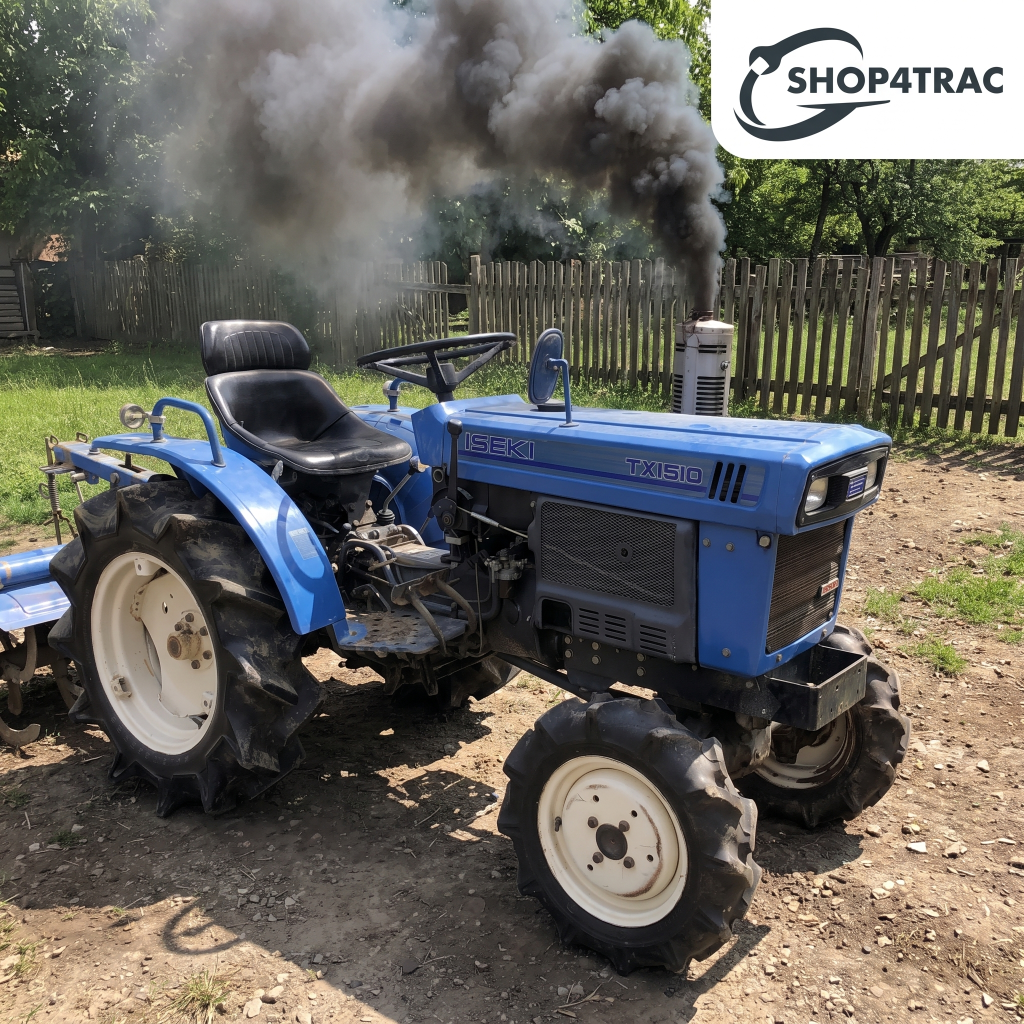
| High fuel consumption / black smoke | Blocked air filter | Clean or replace the element |
| High consumption | Incorrect valve clearance / poor fuel | Adjust valve clearance, replace the fuel |
| Low power | Carbon buildup on injector / low compression | Have the injector and compression checked |
| Oil warning light is on | Low oil, oil too thin, or blocked filter | Check level/viscosity, replace the filter element |
Hydraulics and lift
| Symptom | Likely cause | Solution |
|---|---|---|
| Slow or weak lift | Contaminated suction filter / oil level too low | Clean/replace the suction filter, top up the oil level |
| Implement won't lower | Descent speed lever set to "lock" | Move the lever out of the locked position |
| Squealing sound (relief valve) when lifting | Position of the "up" stopper | Adjust the stopper (lift arm clearance 3–9 mm) |
| Lift remains weak after checking | Worn hydraulic pump | Overhaul or replace the pump |
A practical tip for this Iseki/Bolens series: the hydraulic system uses a suction strainer instead of a replaceable paper filter. With a slow lift, that strainer is often the culprit — so check it before you start on the pump.
Steering and electrics
| Symptom | Likely cause | Solution |
|---|---|---|
| Heavy steering / tractor "pulls" | Incorrect toe-in or uneven tyre pressure | Correct the toe-in and pressure |
| Excessive steering play | Play in tie rod ends / adjusting bolt | Check the adjusting bolt, replace worn parts |
| Battery doesn't charge | Alternator, regulator, or loose V-belt | Check the alternator/regulator, tension the V-belt |
| Lights burn dim | Battery voltage too low / poor earth connection | Charge the battery, clean the earth connection and terminals |
Practical cases from the workshop
Besides the factory tables, there's a wealth of experience from owners who have been maintaining these tractors for decades. A few complaints that keep coming up in practice — with the approach that most often works:
- Difficult starting despite new glow plugs and a full battery. In older TX diesels, this often points to low compression due to worn piston rings. A handy test: with the engine running, disconnect the crankcase breather hose at the intake manifold — if air keeps coming out continuously, or there's a lot of oil in the manifold, the piston rings are worn. The solution is a set of piston rings plus a new head gasket. A clean air filter helps prevent this wear.
- Starts poorly in cold weather. Glow long enough: allow for at least ~20 seconds of preheating before starting the engine. The glow indicator should then glow a dull red. If it stays dark, there's an open circuit or a faulty glow plug — test each plug individually for resistance.
- Turns over but doesn't start after standing idle or after running out of fuel. Bleed the fuel system via the bleed screws (two above the filter bowl, one on the injection pump), starting with the screw closest to the steering wheel. Also check the rubber fuel lines: old, blocked hoses or rust from the tank block the supply.
- Irregular rpm or poor governing. Check whether the engine stop cable opens fully and whether the throttle lever has slipped on the injection pump shaft.
- New oil leak around the hydraulic suction filter. Usually a worn O-ring. First drain the transmission oil (otherwise it will run out immediately as soon as you loosen the bolt), clean the strainer, and use a telescopic magnet to remove any metal particles from the opening. Then top up with fresh transmission oil.
Watch out with grey imports and rebadges
The TX1410 and TX1510 were also sold under other brand names, such as Bolens (G series) and White Field Boss. Parts are largely interchangeable within the three-cylinder TX family, but the exact type designations differ per source and market — so always verify the fit against your serial number and engine, especially for engine and front axle parts. Note the distinction between the three-cylinder TX1410/TX1510 (K3A/K3B engines) and the older two-cylinder TX1300/TX1500: engines and transmissions are not interchangeable between them. Within the TX1410/TX1510, the difference in bore (65 mm K3A versus 68 mm K3B) determines which engine part you need. Part numbers circulating online are useful as a reference, but always check them against your own serial number.
These tractors have the Mitsubishi K3 engine. More about the engine: Mitsubishi K3A–K3F engine: troubleshooting.