



Kubota GL201 – GL301 – GL467 hydraulics, PTO & implements
Kubota GL201 – GL301 – GL467 hydraulics, PTO and implements
Suitable for the entire Kubota GL series: GL201, GL221, GL241, GL261, GL277, GL281, GL301, GL321, GL337, GL367, GL417 and GL467 (also known as the Hinomoto NX series). The power of a GL-series tractor lies not only in the engine, but in what you attach to it. In this comprehensive guide you'll read how the three-point hitch, the power take-off (PTO) and the hydraulics work, how to safely attach an implement, and which tools suit which model.
How the hydraulics and three-point hitch work
The GL series has a JIS category 1 three-point hitch with position control. The hydraulics work independently of the clutch, so you can lift while driving or standing still. With the lift lever you select a fixed height that the hitch holds – ideal for transport and for implements that need to stay at a constant height.
The hitch has a few handy features that are often overlooked on these tractors:
- Float position. If you push the lever all the way forward, the hitch goes into float position. The implement then follows the ground contour – handy for a flail mower or sweeper that needs to follow the terrain.
- Lever stop (repeatable working height). With the adjustable stop on the lift lever you set one fixed working depth. After that you can always return precisely to the same working height – ideal for tillers or ground cultivation.
- Height limit dial. This limits how far the hitch can rise, so an implement never turns too high.
- Adjustable lowering speed + hydraulic lock. With the lowering speed knob you determine how fast the implement lowers; in the "stop" position you lock the hydraulics so the implement stays raised (for example during transport or maintenance).
The hydraulics share the oil bath with the transmission (Super UDT oil). Clean hydraulic oil and a timely replaced hydraulic filter are crucial for a smooth, powerful lift. On the larger models (from the GL367 onwards) the pump delivers ample oil – around 24 liters per minute – for heavier lifting and front loader work.
The power take-off (PTO) in detail
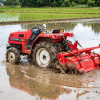
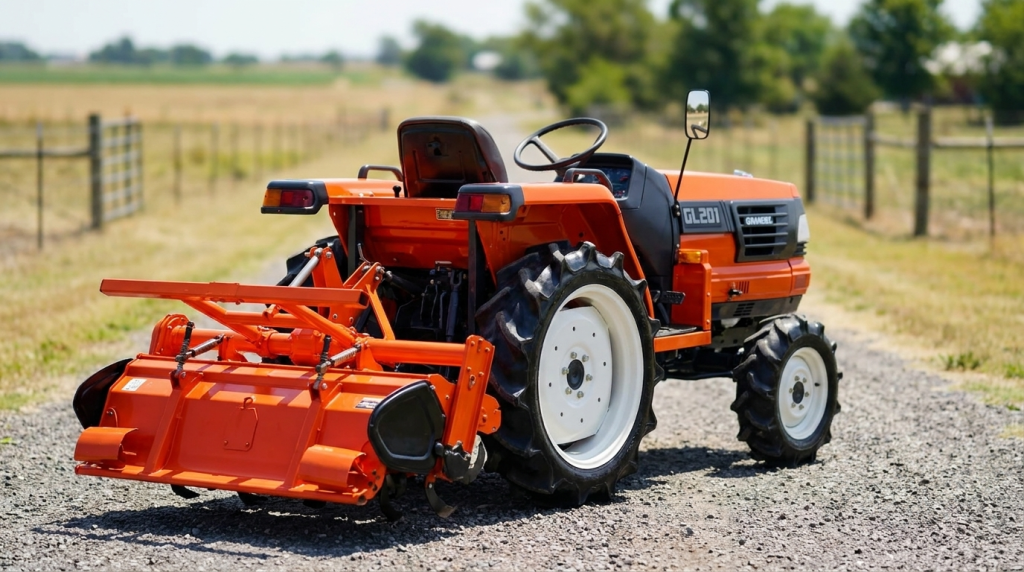
The entire series has a 540-rpm PTO with a standard 1⅝-inch (6-spline) shaft – this fits most implements available in Europe. The PTO drives powered implements such as a tiller, flail mower, rotary mower, sweeper or post hole digger.
For reference, the available PTO output speeds of the GL201 at 2600 engine rpm: 568 / 803 / 985 / 1304 rpm (settings), plus a reverse setting. The larger models have similar settings with more power.
Safe engagement and disengagement: always engage the PTO with the tractor stationary and the engine at low speed, and let powered implements come up to speed gently. Always check that the protective cover is fitted over the PTO shaft and the intermediate shaft before you start, and disengage the PTO before you dismount.
PTO power and lift capacity per model
The available PTO power and lift capacity increase with the model:
| Model | PTO power (approx.) | Lift capacity (approx.) |
|---|---|---|
| GL201 | ± 18 hp | light–medium |
| GL241 / GL277 | ± 23–26 hp | medium |
| GL301 / GL321 | ± 29 hp | ± 900 kg |
| GL367 | ± 32 hp | ± 865 kg |
| GL417 / GL467 | higher | heaviest in the series |
Safely attaching an implement
- Bring the tractor to a stop, engage the handbrake and switch off the engine.
- First attach the two lower lift arms to the implement's pins and secure them.
- Adjust the top link (upper arm) to the correct length so the implement hangs level.
- Slide the PTO shaft onto the power take-off until the lock clicks into place; check that the protective covers are intact and in place.
- Use the lift limiter and lowering speed to set the desired working height and depth.
- Test at low engine speed before starting work.
Which implements suit which model?
Small (GL201–GL281, 21–29 hp). At their best with light to medium implements: a rotary tiller or flail mower up to roughly the track width, a rotary mower, a small tipper or transport box, a sweeper, a sprayer and light ground cultivation. For a full-width tiller or heavy digging work, the smallest models are on the light side.
Mid-range (GL301–GL337, 31–33 hp). Enough power and lift capacity (around 900 kg) for a wider tiller, a heavier flail mower, a post hole digger and a front loader.
Large (GL367–GL467, 36–46 hp). Four-cylinder with ample PTO power and hydraulic capacity for heavier work, a full-fledged front loader, a larger tiller or mower. Always choose an implement that matches the power output, otherwise you'll lose traction and overload the drivetrain.
Front loader, ballast and tire pressure
If you use a front loader or a heavy front attachment, rear ballast is important for stability and grip. Kubota warns never to overload the front axle: keep the front attachment proportional to the tractor's weight and fit a rear weight when using a front loader. When using a loader, increase the front tire pressure to 200 kPa (2.0 bar) (standard is 160 kPa / 1.6 bar). Operate gently and avoid sharp turns with a raised, heavy load.