



Mitsubishi MT14–MT20 hydraulics, PTO and implements
The hydraulics and power take-off (PTO) make your Mitsubishi MT14, MT15, MT16, MT17, MT18 or MT20 truly versatile. On this page you'll read how the position control and automatic tilling depth control work, which PTO speeds are available, and what you can realistically do with 14.5 to 20 hp.
Suitable for the entire series: Mitsubishi MT14, MT15, MT16, MT17, MT18 and MT20 (2WD and 4WD/D).
Mitsubishi MT14–MT20 hydraulic lift
The lift works with position control: the lift arms follow the position of the control lever exactly, so you can set an implement at a fixed, repeatable height or depth. With the adjustable stop, you can lock in a working depth that you can return to every time — ideal for tilling or mowing at a constant height. Push the lever forward and the implement drops under its own weight; set the lever to a particular position and the implement stays at the corresponding height.
Lowering speed and PAC depth control
In addition to position control, the MT series has an adjustable lowering speed: a lever lets you determine how fast the implement lowers. Turning it to the left makes the implement lower faster, turning it to the right makes it slower, and turning it all the way to the right locks the hydraulics so the implement stays in place. When transporting on the road, always set this lever to the locked position — this way a raised implement cannot drop while underway. For tilling work, there's also the PAC (automatic tilling depth control), which automatically keeps the tilling depth constant. The heavier versions were also available as a "Maicon" version with electronic depth control (MAC).
Mitsubishi MT14–MT20 power take-off (PTO)
The PTO is standardised according to JIS 35 and has three speeds: 562, 832 and 1300 rpm. This range lets you drive both slow-turning implements (such as a tipper pump or a winch) and fast-turning ones (tiller, flail mower) at the correct speed. The MT14 through MT16 have a 2-point attachment for the implement; the MT17, MT18 and MT20 have a sturdier special 3-point attachment.
What can you do with 14.5 to 20 hp?
It's important to stay realistic: the stated engine power isn't the same as the power available at the PTO or as pulling force. Some is lost in the drivetrain, so in practice you get somewhat less at the PTO than the 14.5–20 hp on paper. What does that mean in concrete terms?
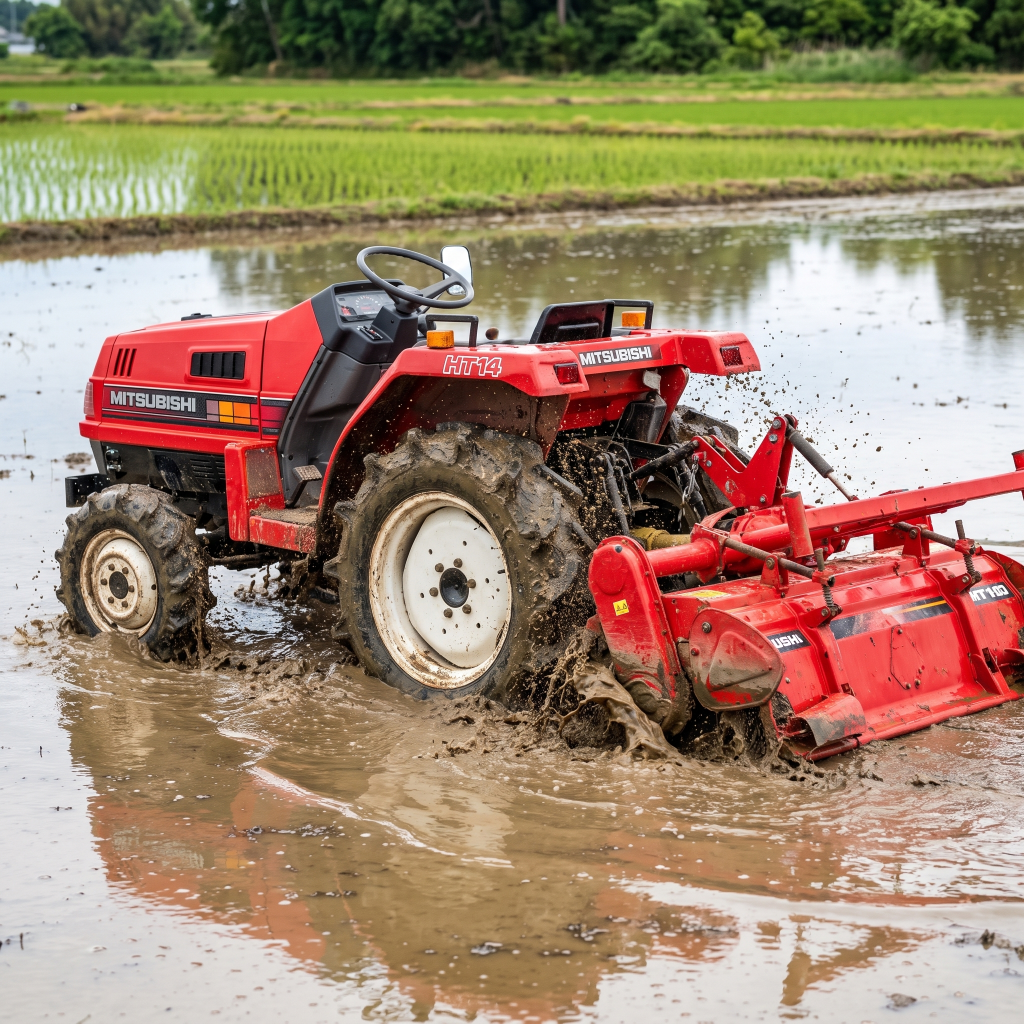
- MT14–MT16 (14.5–16.5 hp): light tilling, a flail mower or rotary mower, a small tipper, transport and yard work. Great for horticulture, riding arenas and lawns.
- MT17–MT20 (17.5–20 hp): heavier tiller, larger mower, light dump bucket or small crane/winch, and more pulling power on heavier ground — especially in 4WD.
The series isn't intended for genuine ploughing on heavy clay; these are light, agile machines for maintenance and lighter groundwork. With the right choice of implements and the diff-lock for extra grip, you can get surprisingly a lot out of them.
Adjusting track width
The track width can be adjusted on each model by turning the rims or wheel discs around, so you can make the tractor narrower for working between rows or wider for extra stability. The exact adjustment ranges are listed per model in the manual; after adjusting, always check the toe-in (front tracking) and correct it if necessary.