



Kubota 05 Series cooling: preventing overheating
The Kubota 05 Series cooling deserves more attention than many owners think, because overheating is by far the biggest killer of these engines. A warped or cracked cylinder head and a blown head gasket are almost always the result of a cooling system that was no longer doing its job properly. In this guide you'll learn how the cooling system works, what causes overheating, and how to stay ahead of it.
Suitable for the entire series: D905, D1005, D1105, D1305, V1205, V1305 and V1505 (incl. turbo -T/-TE and versions -E/-E2B/-E3B/-E4B).
Kubota 05 Series cooling system: how it works
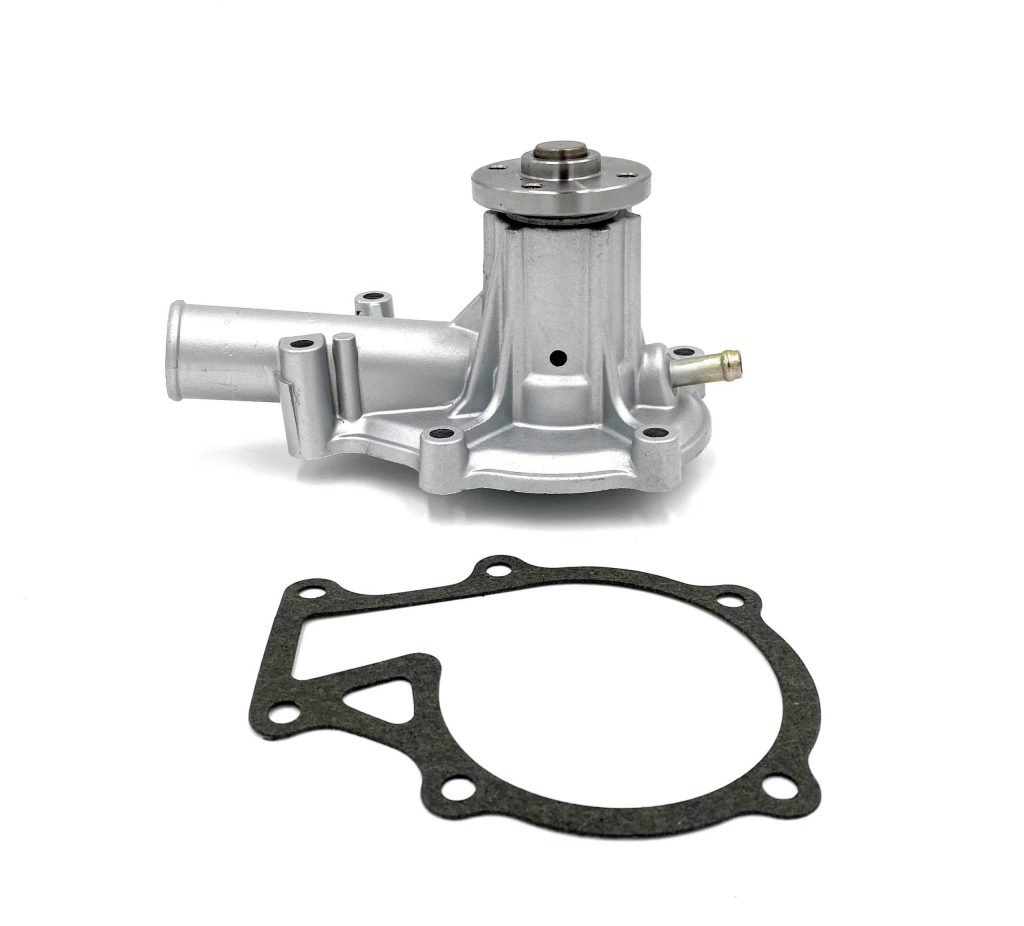
The 05 Series is water-cooled. The water pump (driven by the V-belt) circulates coolant through the block and head. The thermostat keeps the coolant circuit closed until operating temperature is reached, then opens towards the radiator, where the fan dissipates the heat. The radiator cap keeps the system pressurised, so the coolant doesn't boil at higher temperatures.
The coolant capacity (engine only, excluding the radiator) differs per engine version:
| Version | Coolant (engine only) |
|---|---|
| 3-cylinder (D905 / D1005 / D1105) | 3.1 L |
| 4-cylinder (V1205 / V1305 / V1505) | 4.0 L |
Kubota 05 Series overheating: why it's so dangerous
An engine that runs too hot pays the price at the top of the head. Aluminium and cast iron expand differently; when overheating occurs, the head can warp or crack. The result is a leaking head gasket, white smoke, coolant loss, and in the worst case, gases entering the cooling system. Important to remember: the 05 Series has dry liners, so coolant in the oil almost always comes from the head or the gasket, not from a "cracked liner". Prevention really is much cheaper than the cure here.
Kubota 05 Series causes of overheating and how to tackle them
Most overheating problems have a surprisingly simple cause. Work through these points in order:
| Cause | Solution |
|---|---|
| Clogged grille / radiator (most common) | Clean the grille and radiator fins, remove chaff and dust |
| Coolant level too low | Check level and top up; trace leaks |
| Contaminated air filter | Clean or replace (increases load and temperature) |
| Thermostat stuck closed | Test the thermostat in boiling water to see if it opens; replace if faulty |
| Defective water pump | Check for leakage and play; replace |
| Scaled / clogged radiator | Flush or have cleaned; replace in case of severe scaling |
| Defective radiator cap | Replace if the pressure drops back within 10 seconds |
Always start with the simplest and cheapest option: clean the grille and radiator and check the level. A clogged grille is in practice the number one cause of overheating in machines that operate in dusty conditions.
Testing the Kubota 05 Series thermostat, water pump and radiator cap
Thermostat. Not sure whether the thermostat opens? Take it out and place it in a pan of heating water. A good thermostat opens at its specified temperature; if it stays closed, it needs to be replaced. Note the correct type: there are 44 mm and (for turbo) 38 mm versions.
Water pump. Check the water pump for leakage at the weep hole and for shaft play. If it leaks or you feel play, replacement is the only proper solution.
Radiator cap. The cap keeps the system pressurised. A simple test: with a good cap, the built-up pressure only drops back after at least 10 seconds. If the pressure drops faster than that, replace the cap.
Kubota 05 Series coolant: the correct ratio
Use a long-life coolant (LLC) and refresh it periodically. Keep the antifreeze concentration below 50%; more is not better and actually worsens heat dissipation. Check the level and colour regularly, and flush the system when refreshing.
Tip from our workshop: have you experienced overheating? Then don't just replace the direct cause but also check the head gasket and the flatness of the head straight away. It's best to replace the water pump and thermostat together, so you're done in one go.
- Water pump 05 Series (VAR-0034, €69.50): view the water pump 05 Series
- Water pump D1005–V1505 (SKU-360, €69.50): view the water pump D1005–V1505
- Thermostat 44 mm (SKU-45005, €29.50): view the thermostat 44 mm
- Thermostat 38 mm turbo (SKU-45009, €32.50): view the thermostat 38 mm
- Thermostat housing + thermostat + gasket (VAR-46009, €44.50): view the thermostat housing
- Cooling fan 05 Series (VAR-0180, €56.50): view the cooling fan