




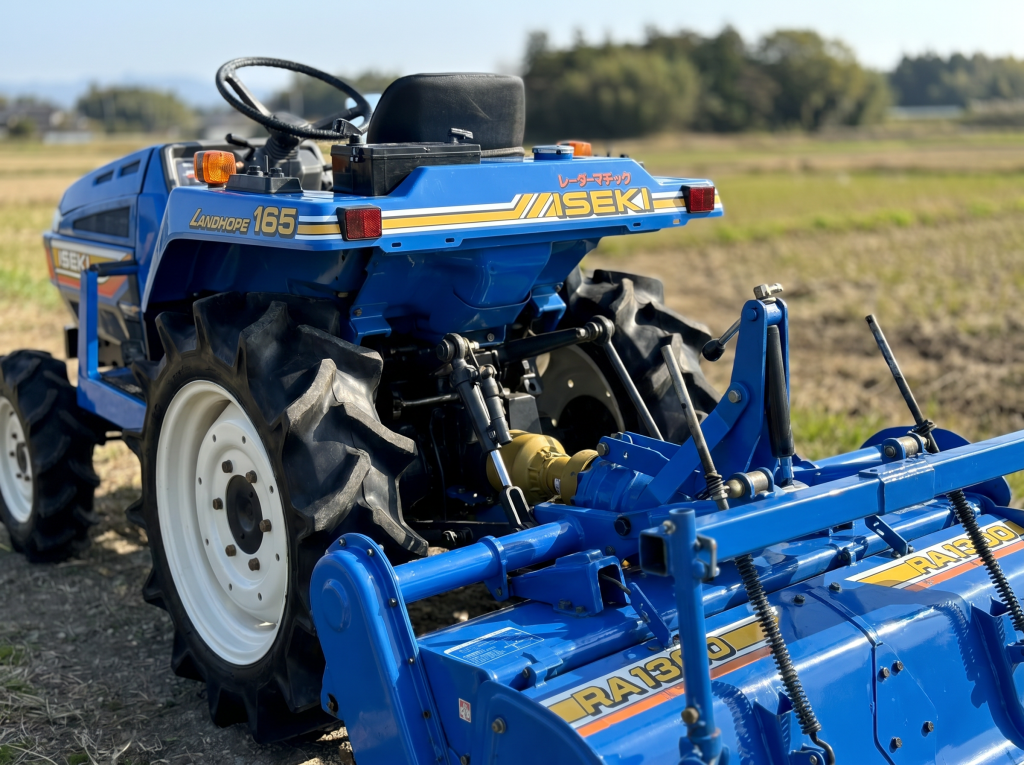
Iseki TU165 hydraulics, PTO and implements: what can you do with it?
Iseki TU165 hydraulics, PTO and implements: what can you do with it?
The PTO (power take-off) and lift system largely determine what you can actually do with your Iseki TU165. In this article, we explain how the PTO system works, what speeds your tractor achieves, and which implements are realistic at each power level in the series.
Suitable for the entire series: Iseki Landhope TU145, TU155, TU165 and TU175 (2WD and 4WD versions).
Iseki TU165 PTO speeds
| Model | PTO speeds | PTO shaft |
|---|---|---|
| TU145 / TU155 / TU165 | 541 / 735 / 1188 rpm | Spline size 35mm |
| TU175 | 514 / 698 / 1128 rpm (slightly different) | Spline size 35mm |
Most implements (flail mowers, rotary tillers) are designed around the 540rpm setting, which conveniently corresponds to the lowest PTO setting on this series.
Iseki TU165 lift system
All models in the series have a hydraulic lift system with position control and a rotary 2-point (2P) hitch system. Position control means the lift arms move to the position you set with the lift lever and hold that position — useful for maintaining a consistent working depth, for example with a tiller. The 2P hitch system is the standard attachment method for light to medium-duty implements in this power segment.
Iseki TU165: PTO power versus drawbar pull
A common misconception is that the tractor's horsepower rating directly determines what you can do with an implement. In practice, there are two distinct types of "power" that need to be kept separate:
- PTO power is the power transmitted through the power take-off to an implement, such as a flail mower or rotary tiller. This power is taken directly from the engine and therefore determines how heavy-duty (wide, thick vegetation, hard soil) a driven implement can be.
- Drawbar pull is the force the tractor transmits to the ground through its wheels, for example to pull a plough or a trailer. This depends not only on engine power, but also on the tractor's weight, tyre size, and whether you have 2WD or 4WD.
For this reason, a 4WD version with the same engine power often pulls slightly more than a 2WD version, while the PTO power (and therefore what a tiller or mower can handle) remains identical.
Iseki TU145-175: which implements suit which power level?
| Model | Power | Realistic implements |
|---|---|---|
| TU145 | 14.5 hp | Small rotary tiller, light flail mower, brush cutter, small snow plough |
| TU155 | 15.5 hp | Medium rotary tiller, flail mower, reel mower for lawns, trailer for light transport |
| TU165 | 16.5 hp | Heavier rotary tiller, flail mower on rougher terrain, plough for light soil, front loader for light-duty work |
| TU175 | 17.5 hp | Heavier rotary tiller, reel mower for larger areas, plough, occasionally a front loader with limited lift capacity |
Keep in mind that these are indicative examples — actual load capacity also depends on soil conditions, the condition of your tractor, and the weight of the implement itself.
Iseki TU165: watch out for the shared hydraulic oil
As we explain in our engine oil & fluidsblog, the lift system shares its oil with the transmission/gearbox (12 litres of gear oil). If the hydraulic pressure doesn't build up properly, first check the engine speed (use 1000-1500rpm), the oil level in the transmission, and the hydraulic filter before assuming a faulty pump. See our troubleshootingblog for the complete list of causes.
Connecting an implement to the PTO? The PTO drive shaft Iseki TU Landhope (€72.50) is the correct PTO shaft connection for this series. If the hydraulics don't build up enough pressure, the hydraulic pump Iseki TX/TU (€238.50) is the part to check.