



Buying a Yanmar AF-15 to AF-18: experiences, strengths and weaknesses
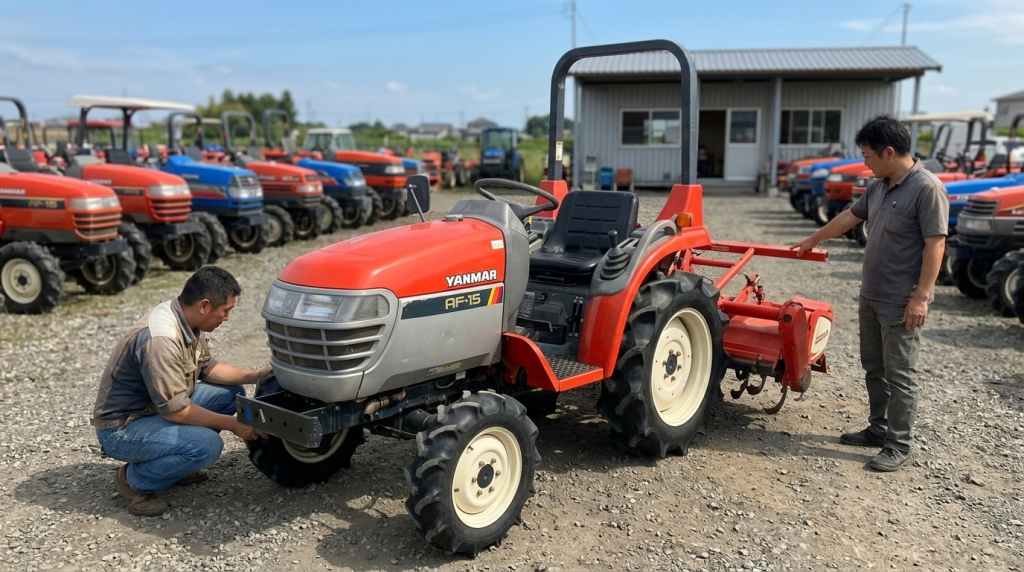
The Yanmar Forte AF-15, AF-16, AF-17 and AF-18 are compact 4WD diesel tractors from the 1990s that, as Japanese imports, are also widely used in the Netherlands and Belgium on horticultural businesses, riding schools and by private owners. In this buying guide, we outline the differences between the four models, honestly point out the strengths and weaknesses, and provide a checklist for viewing one in person.
Suitable for the entire series: Yanmar Forte AF-15, AF-16, AF-17 and AF-18, including the Y (safety frame), U (OK-UFO), U1 (EC-UFO), F (orchard), V (Hi-Grip), B (reverse PTO), R (creep gear), P (power steering), T (turf/lawn), K (quick-hitch) versions and the Limited models.
Yanmar AF series: which models are there?
The Forte AF series was built from roughly 1992 to 1996 (indicative) and succeeded the Yanmar F series. All four models share the same chassis with a wheelbase of 1350 mm, an overall length of 2620 mm and a 3-cylinder water-cooled diesel engine rated at 2500 rpm.
| Model | Engine | Displacement | Power | Weight (with lift) |
|---|---|---|---|---|
| AF-15 | Yanmar 3TNA72 | 879 cc | 15 hp / 2500 rpm | 720 kg |
| AF-16 | Yanmar 3TNA72 | 879 cc | 16 hp / 2500 rpm | 730 kg |
| AF-17 | Yanmar 3TNE74 | 1006 cc | 17 hp / 2500 rpm | 740 kg |
| AF-18 | Yanmar 3TNE74 | 1006 cc | 18 hp / 2500 rpm | 750 kg |
Pay attention to the spelling when searching: the AF-15 through AF-18 (with hyphen) is a different series from the later Forte AF150 through AF180. So a listing for a "Yanmar AF150" refers to the successor model, not this machine. If in doubt, always check the nameplate and engine code.
Yanmar AF-15/16 or AF-17/18: the real difference
The main distinction lies under the bonnet. The AF-15 and AF-16 have the 3TNA72 with a 72 mm bore (879 cc); the AF-17 and AF-18 have the larger 3TNE74 with a 74 mm bore and longer stroke (1006 cc). This means that engine parts such as head gaskets are not interchangeable between the two groups: for the AF-15/16 the head gasket 3TNA72 (SKU-65088)fits, while for the AF-17/18 the head gasket 3TNE74 (VAR-0065)is used. Filters, water pump, thermostat and glow plugs, however, are the same across the whole series.
There are also clear differences between versions: the Limited models (AF-16/AF-18) have no creep gears and no reverse PTO, the orchard version (AF-15/AF-17) is built lower with smaller tyres, and the turf version (AF-16/AF-18) has wide lawn tyres, standard power steering and, as the only one, an engageable and disengageable front-wheel drive.
Yanmar AF series: strengths
The engines from the 3TN family are known to be virtually indestructible with normal maintenance, and since the same blocks were also used in compact tractors from other brands and in industrial machinery, engine parts are readily available. The machine is compact (from 1050 mm wide), manoeuvrable, and at 720–750 kg light enough for lawns and soft ground, while the differential lock and four-wheel drive provide plenty of grip. The transmission with 8 forward and 8 reverse gears (12 with the creep version) and the shuttle lever next to the steering wheel make it pleasant to operate. The hydraulic lift with position control and automatic tilling depth control (auto-rotary) is comprehensive for this class.
Yanmar AF series: weaknesses and points of attention
To be fair, there are also points to keep in mind. It's a grey import: official Yanmar dealers generally do not supply parts for these Japanese domestic models, so you're reliant on specialised aftermarket suppliers. Engine parts are easy to find; bodywork and electronics are more difficult. In practice, mostly age-related issues occur: hardened fuel lines that draw in air, a clogged tank strainer, worn glow plugs that make cold starting difficult, and voltage regulators that fail after incorrect jump-starting. On the OK-UFO and EC-UFO versions (automatic depth and slope control), sensors and the controller can develop faults; replacement electronics are scarce, so test these functions thoroughly before buying. Also keep in mind that the original Japanese lighting does not meet Dutch road requirements without modification.
Yanmar AF-15 to AF-18 market value: what does it cost?
Based on the current supply from Dutch, Belgian and German dealers and the Japanese export market (mid-2026), these are realistic guide prices. These are asking prices — expect some room for negotiation — and the AF-17/AF-18 is generally at the upper end of the range, the AF-15/AF-16 at the lower end.
| Situation | Indication |
|---|---|
| Japanese auction/export condition, untested (excl. transport and customs clearance) | €1,000 – €2,000 |
| Dealer NL/DE, running and tested, without tiller | €3,500 – €4,500 |
| Good condition, with tiller and/or flail mower, serviced | €4,500 – €5,500 |
| Fully overhauled and repainted, often with tiller | €6,500 – €8,500 |
Price-determining factors are mainly the hour count (300–800 hours is quite common for this grey import; above 1500 hours the price drops noticeably), a demonstrably working UFO/lift automation (faulty electronics are often converted to manual operation in practice — acceptable, but it lowers the price), an included tiller (expect €400–800 added value), the condition of the tyres and adapted road lighting. All amounts are indicative.
Viewing a Yanmar AF-15 to AF-18: what to look out for
Start the engine cold: the glow plug indicator should go out after 1 to 3 seconds and the engine should then start promptly. Needing to pre-glow two or three times indicates worn glow plugs or a weak battery. Look at the exhaust: a bit of smoke during a cold start is normal, persistent white or black smoke is not. Check that the oil pressure and charge indicator lights go out after starting, that the lift raises and lowers smoothly (and doesn't sag under load), that the PTO engages in all positions, that the diff lock both engages and disengages, and on UFO versions, that no warning lights flash on the panel — flashing indicates a sensor fault. Pull out the dipstick: engine oil that smells of diesel or is overfilled points to a leaking lift pump diaphragm. Finally, check the hour meter in combination with the overall condition; a machine with high hours but demonstrable maintenance is often a better buy than a polished-up machine that has been standing idle.