



Buying a Mitsubishi MT14–MT20: experiences, strengths and weaknesses
Thinking about buying a Mitsubishi MT14, MT15, MT16, MT17, MT18 or MT20? Then you're looking at a series of compact Japanese diesel tractors known for their simplicity and long service life. This MT series was built from the second half of the 1980s to the early 1990s and is a popular choice for horticulture, yard work, riding arenas, and hobby-scale groundwork. In this buying guide you'll read who this tractor is suited for, what its strengths and weaknesses are, and what to look out for when buying a used one.
Suitable for the entire series: Mitsubishi MT14, MT15, MT16, MT17, MT18 and MT20 — both in two-wheel drive and the 4WD version with the "D" suffix (MT14D, MT15D, MT16D, MT17D, MT18D, MT20D).
What kind of tractor is the Mitsubishi MT series?
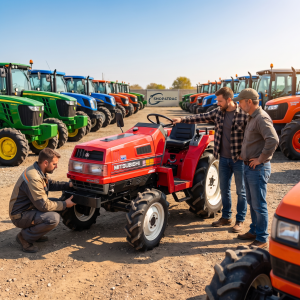
The MT14 through MT20 form one coherent range of light mini tractors in the 14.5 to 20 hp class. All of them have an upright, water-cooled four-stroke three-cylinder diesel engine, a mechanical gearbox with six forward gears and two reverse gears, wet disc brakes, and a differential with a differential lock (diff-lock). They are light, agile machines with a turning circle of just 1.8 to 1.9 metres, making them well suited to small plots.
The main practical difference within the series comes down to two things: power output and drivetrain. The MT14 delivers 14.5 hp, the MT20 delivers 20 hp, and the MT15, MT16, MT17 and MT18 fill in neatly in between. The MT14, MT16, MT18 and MT20 are available in both 2WD and 4WD; the MT15 and MT17 were only supplied as four-wheel-drive models (MT15D, MT17D). For tilling and groundwork on heavier soil, a 4WD version is clearly the better machine.
Mitsubishi MT14–MT20: two engine families
Important to know before you buy: the series uses two different engine families. The MT14, MT15 and MT16 have an L3 engine with indirect injection (swirl chamber): the 808cc L3C in the MT14/MT15 and the 952cc L3E in the MT16. The MT17, MT18 and MT20 switch to the K3 family with direct injection: the K3D (979cc), K3E (1061cc) and K3F (1118cc). Direct injection generally starts a bit more readily and is somewhat more fuel-efficient, but the engines also differ in bore size. This has consequences for parts: head gaskets and gasket sets are not interchangeable between the engine families — and even within the K3 series the bore varies by type. So always order engine parts based on the correct engine type, not just the tractor model.
Strengths
What makes this MT series so appealing is the combination of simplicity and durability. The engines are fully mechanical, with no electronics, and last for thousands of hours with normal maintenance. The controls are straightforward, the weight is low (565 to 745 kg), and the tractors are light enough to transport on a small trailer. The 4WD versions offer surprisingly good grip for such compact machines, and the three PTO speeds plus position control on the lift make them versatile with a tiller, mower, or spreader. Many wear parts — filters, V-belt, clutch, gaskets, valves — are still readily available new.
Weaknesses and points of attention
Let's be honest: this is still a tractor that's thirty to forty years old, often imported through grey-market channels. When buying a used one, pay particular attention to the following:
- Cooling system. Radiator hoses become brittle and crack, and old radiators can leak. Expect to check and replace these if the tractor has been sitting unused for a long time.
- Front axle (4WD). On the D versions, the front axle often has too little or contaminated oil. This leads to costly damage — always check and change the front axle oil when buying.
- Clutch and brakes. A dragging or heavy clutch and worn wet brakes do occur; the clutch kit is available as a complete set for the heavier models.
- Preheating and starting. Difficulty starting from cold often points to worn glow plugs or a faulty glow plug relay. A broken glow timer can even cause glow plugs to burn out during operation.
- Nameplate and numbers. Due to grey imports, naming confusion does occur. An "MT14" from this series (L3C engine) is quite different from, say, an older "MT1401". Check the nameplate as well as the chassis and engine numbers, and order parts based on the engine type.
Which Mitsubishi MT suits which buyer?
If you're looking for a light tractor for a riding arena, lawn, or small yard, an MT14 or MT16 will be more than sufficient. If you want to do serious tilling or tow a small ground scoop on heavier soil, the MT18 and MT20, with their extra power, larger rear tyres, and special 3-point hitch, are the better choice. Keep in mind that the stated engine power (14.5 to 20 hp) is not the same as the power available at the PTO or as drawbar pull: some is lost in the drivetrain. In practice, 14–20 hp means you can comfortably work with light tillers, flail mowers, a small tipping trailer, and groundwork on a horticultural scale — not ploughing on heavy clay.
What does a Mitsubishi MT14–MT20 cost?
Used prices vary widely depending on condition, power, and drivetrain. A basic 2WD needing some attention typically changes hands for a few thousand euros; a clean, ready-to-run 4WD with a tiller costs considerably more. When considering a "bargain", always factor in the backlog of maintenance: cooling, oil in all housings, clutch, and brakes add up quickly. (Estimate based on the second-hand market, last checked June 2026 — not a valuation.)