



Working safely with the Iseki TF15, TF17 and TF19 — rules and regulations
Working safely with the Iseki TF15, TF17 and TF19 — rules and regulations
Driving licence, registration plate, safety frame, coupling brakes, PTO and slope work: everything you need to know before you start up your SIAL.
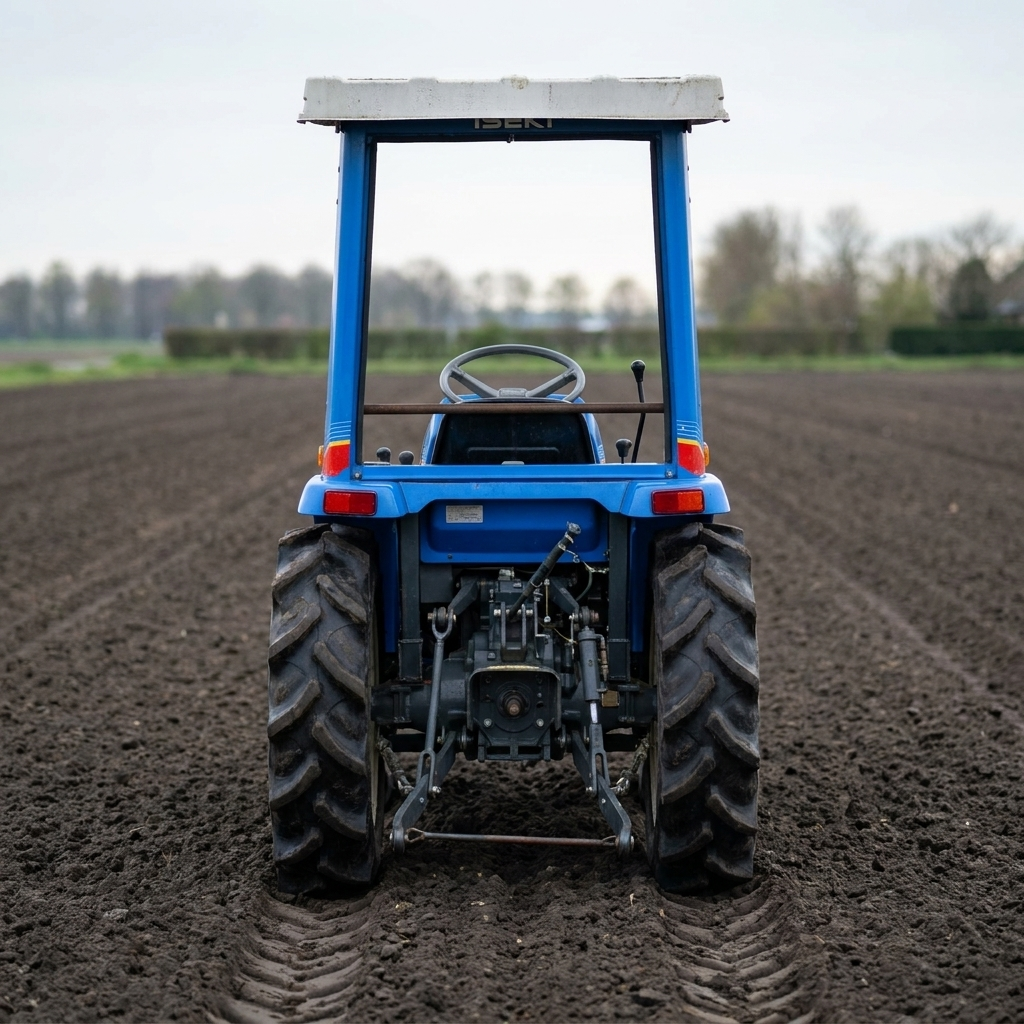
A mini tractor may look harmless, but tractors are responsible for a large number of serious accidents every year. The Iseki SIAL series (TF15, TF17 and TF19) is no exception: a lightweight machine, a high centre of gravity with an implement attached, and a rotating PTO shaft. Most accidents can be prevented with common sense and knowledge of the rules. This blog lists them all — based on the official Iseki manual and Dutch regulations.
Legal requirements: driving licence, registration and insurance
The Iseki SIAL series is type-approved in Japan as a small special vehicle (小型特殊自動車): maximum speed 15 km/h, engine capacity under 1500 cc. In the Netherlands and Belgium, the TF15, TF17 and TF19 therefore fall under the category agricultural or forestry tractor. This has three practical consequences.
Registration plate and registration. Since 2021, all agricultural tractors in the Netherlands must have a registration plate. You must therefore register your SIAL with the RDW before you're allowed on public roads. Do you have a Japanese import without a certificate of conformity? Then registration goes through an individual inspection.
Driving licence. On public roads you need at least a T driving licence . A B driving licence obtained before 1 July 2015 often includes the T licence — check your own situation via the RDW. On your own private land you don't need a driving licence, but Iseki requires that the driver be at least 18 years old.
Insurance. Third-party liability insurance is mandatory as soon as you go on public roads. Iseki also recommends accident insurance — not legally required, but sensible for a vehicle you operate with a lifting mechanism and PTO shaft.
The safety frame (ROPS) — never cut it off
The SIAL series has a foldable Roll-Over Protective Structure (ROPS), or safety frame. The standard version has 2 positions (upright and folded down). The H/N version has 3 positions. That frame isn't there for decoration — it's literally the difference between "a scare" and a fatal rollover accident.
The rule is simple: the frame stays upright at all times. On public roads, in the field, during transport — in all normal situations. The only exception is entering a low shed or greenhouse where you physically don't fit underneath. In that case:
- First release the seatbelt.
- Fold the frame down.
- Drive in slowly and carefully.
- Put the frame back upright as soon as you have clearance.
Why release the seatbelt first? Because a folded-down frame offers zero protection in a rollover. With the seatbelt fastened, you're strapped to a tractor without a frame — the worst combination of all the options.
On public roads — the 5 golden rules
With a top speed of 15 km/h you're not a fast road user, but with an implement on the back and a junction up ahead, you can still cause serious damage quickly enough. So run through these five points every time before you leave the yard:
1. Couple the brake pedals. The SIAL has separate left and right brake pedals for fieldwork. On the road you must couple them together with the connecting bracket. Uncoupled brakes = one-sided braking = skidding = rollover. This is the most underestimated cause of road accidents involving small tractors.
2. Deflock off. Check that the differential lock (deflock) is NOT engaged. On asphalt, deflock is extremely dangerous — your tractor won't steer properly and slides straight through a bend.
3. 4WD off. On paved roads, 4WD causes extra tyre wear and can make steering behaviour unpredictable. Switch it off unless conditions genuinely require 4WD.
4. Check the lights. Indicators, headlights, rear lights and reflectors must all work. Is your implement wider than the tractor? Then you're required to fit red markings (daytime) or extra lighting (evening).
5. Track width back to standard. Have you widened the track width for fieldwork? Reset it before going on the road. A non-standard track width makes road behaviour unpredictable.
Working on slopes — where it really goes wrong
Rollovers are by far the number one cause of death when using tractors. The SIAL series is relatively light, and with an implement on the back, the centre of gravity sits high. Of the three models, the TF15 is the lightest — it's precisely with the smallest model that you need to be extra careful on sloped terrain.
The four rules of thumb on slopes:
Straight up, straight down. Always drive slopes perpendicular to the incline, never diagonally. On a diagonal line, the angle at which you tip over is much smaller than you think.
Don't shift gears, don't turn. Changing gear or turning halfway up a slope is asking for trouble. Plan your route before you start.
Engine braking when descending. When going downhill, shift down to a low gear and let the engine do the braking. Relying on the foot brake alone is risky — the brakes can overheat, and on steep descents you can brake unevenly.
4WD on, low gear. On steep sections: always use four-wheel drive and a low gear. The extra grip provides stability, and the low gear prevents you from going too fast.
PTO safety — never underestimate the power take-off shaft
The SIAL's power take-off (PTO) shaft rotates at hundreds of revolutions per minute. A loose sleeve, a scarf, a braid of hair, a shoelace — it gets caught in a fraction of a second, dragging the person along with it. PTO accidents are overrepresented with mini tractors precisely because people underestimate the force involved.
Fixed PTO rules:
Engine off means engine really off. Before adjusting an implement, removing a stone from between the blades, or touching the PTO shaft: switch off the engine, remove the key. Not "just idling", not "just holding it". Off.
PTO guard always on the shaft. Without an implement connected, the guard must be on the power take-off shaft. It might seem optional, but it isn't.
Universal joint guard on the implement. Before engaging the PTO, always check that the implement's universal joint guard is present and can rotate freely. A broken guard = replace it immediately, not "we'll do one more round first".
No loose clothing. No ties, scarves, loose jackets or rings when working with a rotating PTO. Long hair tied back, under a cap or helmet.
Working in enclosed spaces — exhaust fumes are deadly
The SIAL's diesel engine produces exhaust fumes containing carbon monoxide. In a greenhouse, shed or garage, just a few minutes of irresponsible running is enough to make you seriously ill. Carbon monoxide is colourless and odourless — you only notice it when it's too late.
If you're working indoors with the engine running, make sure there's plenty of ventilation: doors open, ventilation on, as briefly as possible. Symptoms of carbon monoxide poisoning include drowsiness, headache, nausea or dizziness. Notice anything? Go outside immediately and stay there — not "just let me finish this first".
Safe working starts with good maintenance
The safety rules above only help if your machine is also technically sound. Broken brakes, worn filters or a clogged fuel system cause failures at the most inconvenient moments — for example, halfway up a slope or on a public road. An annual filter service and thorough brake check are therefore part of the safety protocol.
Checklist: before every drive
Print out this mini checklist and hang it in the shed. Go through it before every drive off the yard:
- ☐ Safety frame upright and secured
- ☐ Seatbelt fastened
- ☐ Brake pedals coupled
- ☐ Deflock off
- ☐ 4WD off (unless conditions require otherwise)
- ☐ Lights checked (headlights, rear lights, indicators)
- ☐ PTO guard present (without implement) or universal joint guard on implement
- ☐ Tyre pressure correct
- ☐ Implement correctly attached and locked
Looking for parts for your Iseki SIAL?
Shop4trac supplies filters, gaskets, coupling sets, lighting and more for the TF15, TF17 and TF19. Fast delivery from the Netherlands.