



Troubleshooting the Yanmar RS-240 to RS-330: faults and solutions
Does your Yanmar RS-240, RS-270, RS-300 or RS-330 refuse to start, run too hot, or won't lift the implement? This article provides the complete fault diagnosis from the original manual, supplemented with known real-world issues that owners of this series encounter — with the likely cause and solution for each fault. Always switch off the engine before starting any troubleshooting.
Suitable for the entire series: Yanmar Forte Rice Special RS-240, RS-270, RS-300 and RS-330 (also known as RS24, RS27, RS30 and RS33), including the R, S, J, U, V and Q versions.
Yanmar RS won't start: starter motor doesn't turn
| Check | Solution |
|---|---|
| Clutch pedal fully depressed? | The safety switch otherwise blocks the starter motor. From practical experience: worn or dirty contacts on this switch are a known cause of "it does absolutely nothing" — test the switch with a multimeter and replace if necessary. |
| Battery full and connected? | Top up fluid, charge; clean terminals, tighten and grease them. |
| Main fuse / fusible link | Replace the fuse (correct rating!); have a discoloured fusible link replaced. |
| Ignition switch or starter motor faulty | Test with a multimeter; have the starter motor overhauled or replaced. |
Yanmar RS won't start: starter motor does turn
| Check | Solution |
|---|---|
| Fuel and fuel tap | Fill the tank, set the tap to "O", bleed the system (tap open, full throttle, start). |
| Air in the fuel system | Bleed the system; then check lines and clamps for leaks. |
| Stop solenoid (fuel shut-off) | A known practical issue on this series: if the solenoid isn't energised, the pump receives no fuel and the engine won't start — or it cuts out during work. Check the plug and fuse, otherwise replace the solenoid. |
| Engine or governor fuse, relay | The RS has separate fuses for the electronic control system (including 15A) plus a main relay and an actuator relay — check and replace them one by one. |
| Pre-glow | If the glow indicator doesn't light up (or the lamp stays off), check the fuse first. |
Yanmar RS runs erratically or loses power
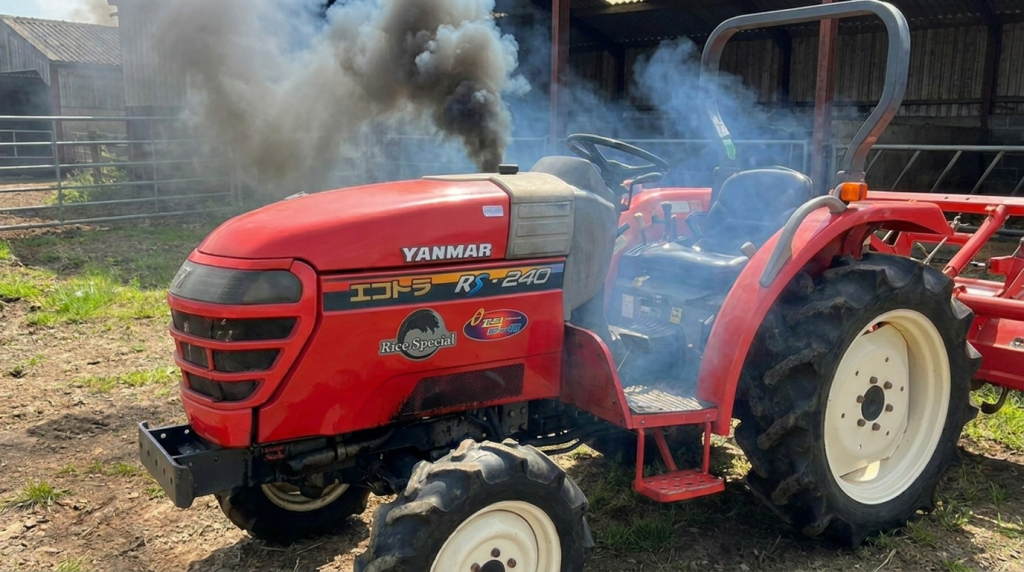
If the engine runs unevenly, check in this order: air in the fuel system (bleed it), water in the fuel (red ring in the filter housing rises → drain and refill with fresh diesel), a clogged fuel filter (clean or replace) and dirty injector nozzles. If the engine lacks power without running unevenly, the air filter is the first suspect; then compression, valve clearance and injection — the latter is a job for the workshop. Black smoke under load indicates a clogged air filter or overload; white smoke points to oil burning or (in cold weather) harmless water vapour.
Yanmar RS overheats
The classic issue on this series, and almost always cheap to fix. Check in this order: coolant level (top up), radiator screen and cooling fins (remove straw and dust — the main cause with flail and mower work), tension and condition of the V-belt (deflection 10–15 mm; if it slips despite maximum tension, replace it), engine oil level, and finally the load (a structurally too-heavy implement will overwhelm any cooling system). If it still runs hot after all this is fine, consider a sticking thermostat or an internally fouled radiator — flush the radiator during the annual coolant change.
Oil pressure or charge warning light comes on during work
Oil pressure light on: stop immediately, check the oil level and top up; if the level is fine, have the oil viscosity, pressure switch and finally the oil pump checked. Charge warning light on: first check the V-belt (tension/breakage), then have the alternator with built-in regulator tested. If the trouble lamp flashes, check the wiring plug connections — corrosion in connectors is a common issue on machines of this age.
Yanmar RS lift doesn't work properly
| Symptom | Cause → solution |
|---|---|
| Implement doesn't lift | Lowering speed valve closed → open it. Transmission oil level too low → top up. Line filter clogged or suction line drawing air → replace filter, check couplings, check O-rings. Then: pump or control valve (workshop). |
| Implement doesn't lower | Lowering speed valve closed → open it. Lift lever still in "lift" position → move lever down. Dirt in the control valve → workshop. |
| Lift doesn't respond to the toggle switch | Check the control fuse, switch contact or (for shuttle-linked functions) the back switch; make sure the height limiter isn't left in the "low" position. |
| Rotor doesn't lower / automatic function doesn't respond (UFO) | A known real-world case: the rotor cover sensor cable runs stiffly or gets stuck, blocking the depth automatic function. Solution: replace the cable and mount it in the old adjustment position. For reference, the same applies to the levelling control: a stuck or broken adjustment cable/UFO cable causes the implement to hang crooked — after replacement, re-level it. (Part numbers vary per version; verify by serial number.) |
| Rotor rises on its own + noise from the pressure relief valve when starting | The rear cover of the rotor is still locked in the raised position → lower the cover. |
Electrical faults
For lighting, indicators and horn, the same checklist always applies: bulb → fuse (fuse box with, among others, 15A/20A/10A groups, plus spares) → plug connection → earth → switch. If a light still doesn't work after all these steps, it points to a broken wire. If a new fuse blows immediately, there's a short circuit in that group: don't keep replacing fuses — have the wiring checked instead.
Clutch and brakes
A slipping or poorly disengaging clutch almost always starts with incorrect pedal play — first adjust it to 20–30 mm before assuming the worst. If the tractor brakes unevenly, equalise the play on the left and right (20–30 mm). If the brake pedal returns slowly or the brake squeaks, check the return spring and lubricate the pedal shafts.