



Starting & operating the Iseki TA: TA207–TA317 manual guide
Starting & operating the Iseki TA according to the manual (TA207–TA317)
Starting an Iseki TA is easy – once you know how the starter safety switch works and what the dashboard lights mean. In this article, we translate the operating chapter from the original Iseki TA series manual into practice, including the official preheating times in cold weather.
Suitable for the entire series: Iseki TA207, TA227, TA247, TA263, TA267, TA287 and TA317 (2WD and 4WD).
Iseki TA starting procedure step by step
The manual prescribes this sequence. Sit in the seat and check that the handbrake is engaged; on the G version, the PTO switch must also be OFF. Set the hydraulic lever to the lowest position. Then fully press the clutch pedal – this operates the starter safety switch, without the clutch pressed the starter motor won't do anything. Put all gear levers in neutral, pull the throttle lever halfway, and turn the ignition key to ON. Now the oil light and the charge indicator light should come on. In cold weather, first turn to the glow position (see below), and then to START. Release the key immediately once the engine starts and check that all warning lights have gone out.
Two important warnings from the manual: never turn the key to START while the engine is already running, and let the starter motor run for a maximum of 10 seconds per attempt. If it doesn't start, wait about 10 seconds before trying again – otherwise the starter motor will burn out.
Iseki TA preheating: how long at which temperature?
At temperatures below -5 °C, the manual states you should preheat for about 20 seconds in the glow position of the ignition switch. Above -5 °C, or with an already warm engine, preheating is not necessary. In the glow position, the glow plugs become red-hot within 20 to 30 seconds; the glow indicator on the dashboard shows when the engine is ready to start. If your Iseki starts poorly in frost, worn glow plugs or a slow glow relay are the first suspects.
Iseki TA dashboard: what the warning lights mean
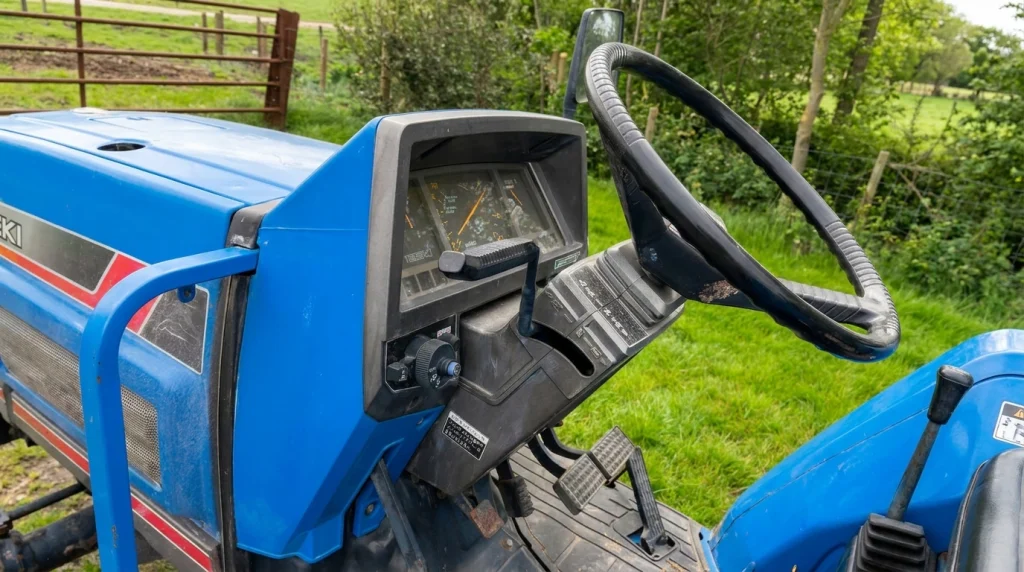
In addition to the fuel gauge, tachometer/hour meter and temperature gauge, the dashboard has a row of warning lights. The charge indicator light (battery symbol) goes out once the alternator is charging; if it stays on, the battery isn't charging – think of a loose or worn V-belt or a faulty alternator. The oil pressure light comes on when oil pressure is too low or engine oil level is too low: stop immediately. The hydraulic filter light warns that the hydraulic filter is getting clogged. There are also version-dependent lights: the PTO light (G version), the super full-turn light (K version, only lights up when the function is on, 4WD is engaged and the range lever is in LL, L or M) and the backup light for the electronic lift (WX version). Use the monitor check switch to verify that the hydraulic filter light itself is still working.
Iseki TA running-in and warming up
After a cold start, let the engine warm up for a few minutes before applying load; in severe cold, the manual recommends a longer warm-up (up to 20–30 minutes in extreme frost) so the hydraulic and transmission oil reaches operating temperature. Run in a freshly overhauled or newly purchased machine gently for the first 50 hours and then change the engine and transmission oil – see also our Iseki TA maintenance schedule.
Product tip: cold-weather starting problems often start with the glow plugs – the Glow plug Iseki TA (SKU-554016-5) is available separately. Lost your key? The Ignition key Iseki TA series (SKU-IS1) solves that. If the starter motor does nothing at all, check out the Starter motor for the TA series (SKU-129011).