



Iseki TA rear lift, PTO & hydraulics: how it works | TA207–TA317
Iseki TA rear lift, PTO & hydraulics: how it works (TA207–TA317)
The rear lift is the heart of every Iseki TA Landleader – and, on many versions with electronic control, also the part we get the most questions about. In this article we explain the complete lift and PTO installation based on the original manual: from adjusting the three-point lift to the electronic horizontal levelling control of the WX version.
Suitable for the entire series: Iseki TA207, TA227, TA247, TA263, TA267, TA287 and TA317 (2WD and 4WD).
Iseki TA three-point lift: category 1 (JIS)
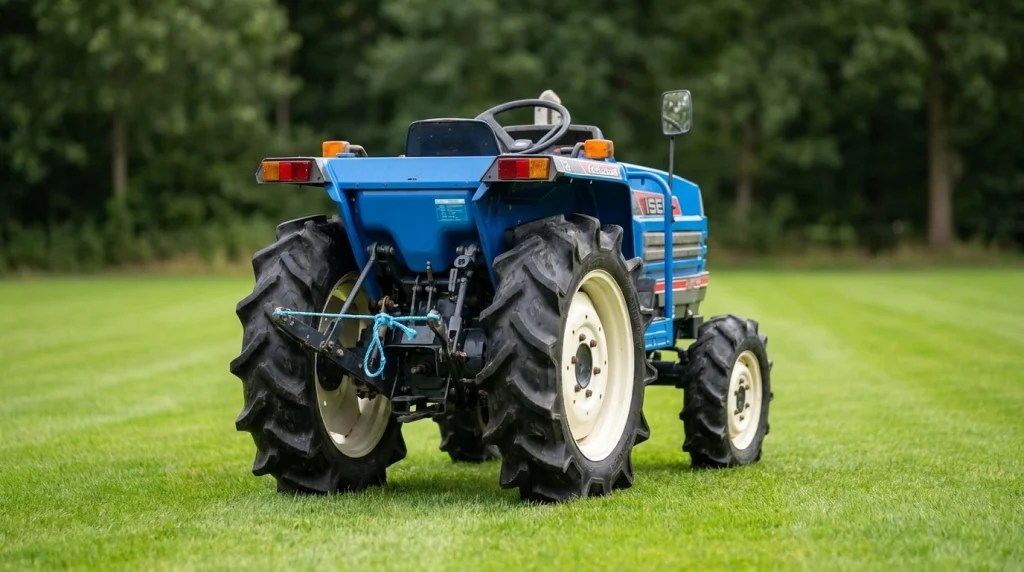
The TA series has a three-point linkage according to JIS shape 1, comparable to cat. 1, with two lift arms (lower links), a top link and stabiliser chains. The lift mechanism works with position control: the position of the control lever directly determines the height of the lift arms. Important note from the manual: use only the tow hitch for pulling work – never the top link mount or the lift arms, as this can cause the tractor to tip over backwards.
Adjusting the Iseki TA lift rods and chains
On the right-hand side there is an adjustable lift rod with a turning handle: turning clockwise shortens it, turning counterclockwise lengthens it. This lets you level an implement from left to right. After adjusting, lock the handle – on the TA207, TA227 and TA263 with the lock nut, and on the TA247, TA267, TA287 and TA317 with the stopper. The lift rods also have two mounting holes on the lift arm: one position for a rotary tiller/cultivator and one for other implements. Fit the pin in the correct position (plate facing upward, pin in the direction of the arrow). Adjust the stabiliser chains according to the implement: slightly loose for a plough or harrow (5–6 cm of sideways play), and slightly tensioned for a tiller. Without an implement, secure the lift arms with the supplied rubber blocks so they don't strike the tyres. The top link is normally set in the upper hole of the mounting bracket.
Setting up the Iseki TA lift: lift height, lowering speed and depth
On the control panel next to the seat you'll find several dials, depending on the version. The lift height knob (上げ位置) limits how high the lift can rise – useful so the tiller doesn't hit the cab or PTO countershaft. The lowering speed knob (下げ速度) determines how quickly the implement lowers; in the "lock" position the implement stays raised, for example during transport. Never leave a raised implement on the lock setting while working on it. The depth control (耕深) keeps the working depth constant while tilling, and the sensitivity knob determines how aggressively the system corrects.
Iseki TA electronic lift (WX): horizontal levelling control and backup
The WX version has a fully electronic hydraulic system: an electronic control block operates an additional lift cylinder via solenoid valves, with sensors that feed back the position. The horizontal levelling control has an automatic mode (the implement stays level relative to the horizon, via the tilt sensor) and a parallel mode (the implement follows the tractor, via the stroke sensor on the cylinder). With the backup function , the implement automatically rises as soon as you put the direction lever into reverse – the backup light on the dashboard indicates that the function is active. Note: backup does not work if the implement was already raised using the position lever. When starting up, there is also a safety start: the electronic lift stays locked until you deliberately release it, so an implement can never drop unexpectedly when the ignition is switched on. You can find more background information in our earlier article on the electronic rear lift of the Iseki TA.
Because this system operates electrically, it is sensitive to the classic age-related issues: corrosion on earth points, dried-out connectors and a tired battery. Our article on Iseki TA faults contains the complete step-by-step plan for a lift that no longer responds.
Iseki TA PTO: four speeds
The PTO shaft (35 mm, 6 spline) has four speeds: 565, 733, 1060 and 1244 rpm on the TA207 through TA267, and 565, 732, 1053 and 1233 rpm on the TA287 and TA317. The G version has an independent PTO with its own on/off switch, safety relay, and choice between manual and automatic engagement; on the other versions, the PTO is operated via a lever. Always engage the PTO at low engine speed and switch it off before transport.
Iseki TA: what can you do with 20 to 30.5 hp?
In practical terms: a TA207 with 20 hp easily powers a 1.0–1.2 metre tiller, a lawn flail mower or a single-furrow plough. The mid-range models (TA247–TA267) can handle a tiller up to about 1.4 metres and heavier flail mowers, while the TA287/TA317 can take on 1.5–1.6 metre tillers, wood chippers and transport work. Keep in mind that PTO power is different from pulling power: for PTO work (tilling, mowing), engine power counts almost one-to-one, whereas for pulling work the weight of just over 1000 kg is the limiting factor. With the 16 gears, you'll find a suitable driving speed for every implement at full PTO speed.
Product tip: you'll find lift and attachment parts for the TA series in the lift sets and rear lift hydraulics categories in the shop. For a PTO shaft with a different connection, there are PTO adapters, and if the lift hydraulics leak at the connections, check out the seals for the TA207 – TA317 (SKU-96065).