




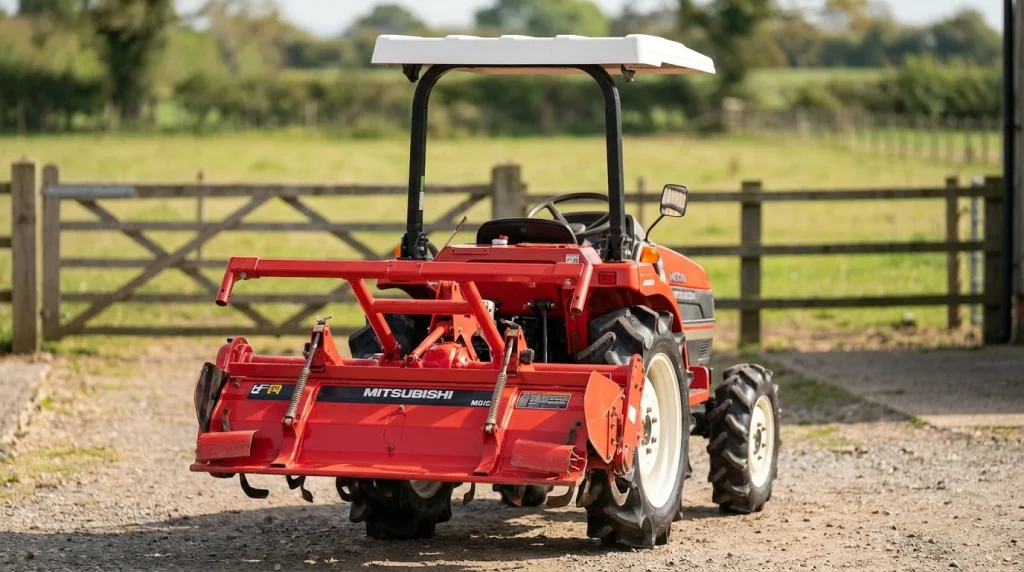
Mitsubishi MT161–MT241 hydraulics, PTO & implements: what can you do with 16–24 hp?
Mitsubishi MT161–MT241 hydraulics, PTO & implements
What can you really hitch behind a Mitsubishi MT161, MT181, MT201, MT221, MT241 or MTZ? In this blog we go through the hydraulics, the 3-point linkage and the PTO, and indicate per power class which implements are realistic — including the original attachments Mitsubishi itself supplied for this series.
Suitable for the entire series: Mitsubishi MT161, MT161S, MT181, MT201, MT221, MT241, MT241S, MTZ18, MTZ20, MTZ200, MTZ21 and MTZ23.
Mitsubishi MT series 3-point linkage and lift control
The entire series has a 3-point linkage according to JIS category 0 — comparable to the European cat. 1 size but with smaller eyes and a 35 mm PTO shaft. European cat. 1 implements often fit with adapter bushings. The lift works with position control: the lever determines the lift height and the implement stays at that setting. Depending on the version, there is additional electronics on board: PAC is the basic control, JAC adds automatic functions and MAC is the most complete version with, among other things, a depth control for the rotary tiller. Handy to know: the lowering speed of the lift is adjustable with the lowering speed knob, and in the "locked" position the lift doesn't lower at all — the standard solution if you want to transport an implement safely in the raised position, but also the explanation for why a lift sometimes "refuses to lower".
Mitsubishi MT series PTO: three speeds plus reverse
The PTO has three speeds plus a reverse setting (reverse PTO): 532/832/1,355 rpm on the S3L models and 564/809/1,321 rpm on the S3L2 models, with reverse at 898 and 1,042 rpm respectively. The reverse setting is intended for the original Mitsubishi rotary tillers that till in reverse; only use it with implements suitable for this. For standard 540-rpm implements, use the lowest PTO setting at nominal engine speed.
Mitsubishi MT161–MT241: what can you do with 16–24 hp?
Important distinction: PTO power determines what you can drive, weight and pulling power determine what you can tow. A machine of 800–900 kg cannot pull a three-furrow plough, no matter how healthy the engine is. Realistic guidelines from practice:
| Power class | Realistic implements |
|---|---|
| 16–18 hp (MT161, MT181, MTZ18) | Rotary tiller up to ±1.10 m, lawn aerator, meadow harrow, rotary mower ±1.20 m, tipping trailer up to ±1,500 kg total, sweeper, snow blade |
| 20–22 hp (MTZ200, MT201, MTZ21, MT221) | Rotary tiller 1.20–1.40 m, single-furrow plough, flail mower ±1.20 m, wood chipper (light), backpack sprayer/field sprayer, small potato digger |
| 23–24 hp (MTZ23, MT241, MT241S) | Rotary tiller up to ±1.50 m, flail mower 1.30–1.50 m, heavier tipping trailer, small bale spike, log splitter via PTO, heavy single-furrow reversible plough |
Mitsubishi MT series original attachments
Mitsubishi supplied an extensive range of attachments for this series, which you regularly find with the machines on the Dutch market: a tow hitch/linkage drawbar (JIS-0), bumper weights of 20–30 kg (up to 5 pieces), rear wheel weights of 34 kg (4 pieces), adjustable quick couplers ("Super Hitch") for mid-mount and side rotary tillers, hillers and ridgers, cage wheels for wet fields and — only for the versions with power steering — the factory front loader with a lifting capacity of 250 kg, available with standard bucket, rubble bucket, manure fork, pallet fork, bale spike and even a small grader blade. If such a loader is fitted on the machine you have your eye on, check the play in the loader arms and the condition of the hydraulic hoses.
Mitsubishi MT series: ballast and safety
With a heavy implement in the lift, the front axle becomes light. Use front weights with heavy attachments and stick to the lowest gear on slopes. For transport on public roads: differential lock off, Dia Quick Turn off, pedals coupled and the implement secured in the highest position with the lowering speed control set to "locked".
💡 Product tip: Noticing that the lift is becoming slow or whining when lifting? First replace the hydraulic filter (SKU-250007) and check the transmission oil level — together responsible for the vast majority of all lift complaints on this series.