




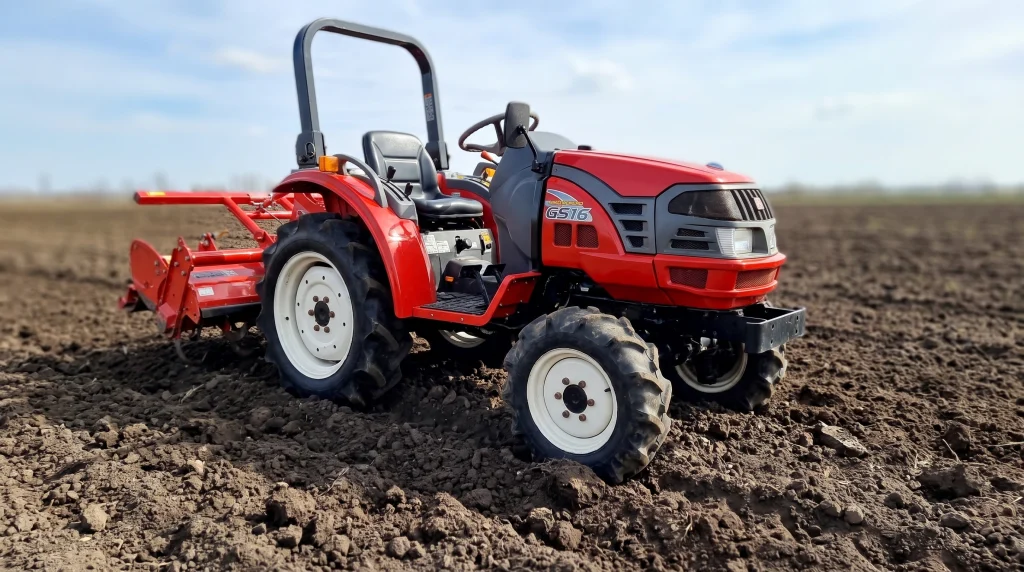
Mitsubishi GS16-GS25 hydraulics, PTO & implements
Mitsubishi GS16-GS25 hydraulics, PTO & implements
What can you really do with the hydraulics and PTO of your Mitsubishi GS16-GS25? This page explains the three-point hitch, the PTO shaft, and the automatic lift control, and gives an honest picture of which implements suit 16 to 25 hp — for the GS16, GS18, GS20, GS21, GS23 and GS25.
Suitable for the entire series: Mitsubishi GS16, GS18, GS20, GS21, GS21S, GS23, GS25 and GS25S.
Mitsubishi GS16-GS25 three-point hitch
The GS series has a category 0 (JIS 0) three-point hitch, operated with position control: you set the lift lever to a position and the lift keeps the implement at that height. Depending on the version, there is automatic height, depth, and tilt control. Pull the position control lever back gently to raise the implement.
Mitsubishi GS16-GS25 PAC, JAC and MAC explained
The GS series was supplied in three equipment levels, recognizable by the control panel:
| Version | What it can do |
|---|---|
| PAC | Basic position control of the lift height |
| JAC | Position control + automatic tilt control |
| MAC | Position control + automatic tilt and depth control |
With the JAC and MAC versions, the tractor automatically adjusts the implement position via potentiometers and sensors. Handy for tillers and soil cultivation, but it's also the system that tends to need attention first after years of use: a faltering automatic function is often caused by a dirty or worn sensor. If in doubt, switch off the automatic function and work with manual position control.
Mitsubishi GS16-GS25 PTO (power take-off)
The PTO is a JIS 35 shaft with multiple speeds, allowing you to drive the implement at the correct speed:
| Model | PTO speeds forward | Reverse |
|---|---|---|
| GS16, GS18, GS20, GS21, GS21S | 566 / 816 / 1,310 rpm | 952 rpm |
| GS23, GS25, GS25S | 589 / 849 / 1,362 rpm | 990 rpm |
For most tillers and mowers, you use the speed around 540 (the lowest setting). The reversible PTO (reverse) is handy for freeing up a clogged tiller.
Mitsubishi GS16-GS25: what can you do with 16 to 25 hp?
Important to stay realistic: the stated power is engine power. At the PTO and the towbar, less of that remains. With a curb weight of 780 to 880 kg and 4WD, you can comfortably do light to medium-heavy work with this series, but not heavy plowing like a large agricultural tractor.
- GS16-GS20 (16-20 hp): soil tiller up to approx. 1.0-1.2 m, flail mower, rotary mower, moldboard plow, transport box, light tipping trailer, snow blade. Ideal for gardens, yards, riding arenas, and park maintenance.
- GS21-GS25 (21-25 hp): heavier tiller up to approx. 1.3-1.4 m, larger flail mower, small plow, spading machine, and heavier transport tasks. The extra torque and weight help on slopes and in compacted soil.
Mitsubishi GS16-GS25 ballast and safe lifting
If you want to use a heavy implement or front loader, make sure to provide counterweight (ballast at the front or rear) to keep the tractor stable and controllable. Work on level ground, never lift more than the machine can handle, and always place a support when working under a raised implement — don't rely on the hydraulics alone. If you use a front loader, keep in mind that the transmission oil level drops; check and top up to the upper mark.
Product tip. A slow or faltering lift is often caused by a clogged hydraulic filter or too little transmission/hydraulic oil. The hydraulic filter is included in the GS service line; also check the oil level (see engine oil & fluids). If the power steering feels heavy or the hydraulics run hot, replace the oil and bleed the system.