



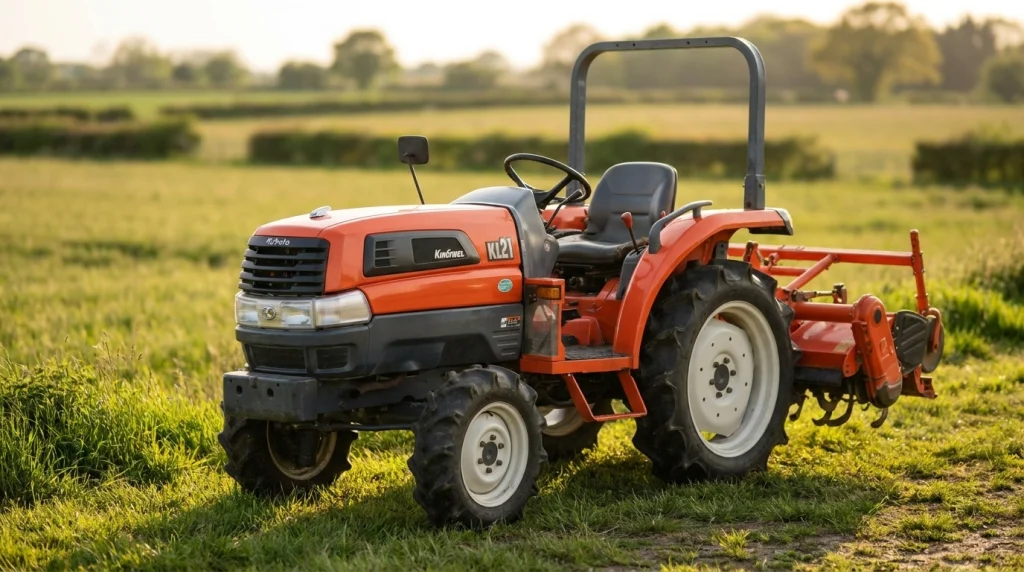
Kubota KL Series Specifications: All Models Overview (KL21–KL50H)
Looking for the specifications of the Kubota KL series? Below you'll find the key technical data for all models, taken directly from the original factory manual. Useful for purchasing, maintenance, or choosing the right implement.
Suitable for the entire KL series: KL21, KL23, KL25, KL27, KL30, KL33, KL36, KL43 and the H-variants KL28H, KL31H, KL34H, KL38H, KL41H, KL46H and KL50H.
Kubota KL21 through KL33: dimensions and weights
| Specification | KL21 | KL23 | KL25 | KL27 | KL30 | KL33 |
|---|---|---|---|---|---|---|
| Length (mm) | 2965 | 2965 | 2965 | 3080 | 3180 | 3180 |
| Width (mm) | 1220 | 1245 | 1245 | 1350 | 1420 | 1460 |
| Height (mm) | 1955 | 1955 | 1990 | 1980 | 1980 | 1980 |
| Wheelbase (mm) | 1550 | 1550 | 1550 | 1670 | 1745 | 1745 |
| Ground clearance (mm) | 335 | 335 | 350 | 345 | 360 | 360 |
| Weight (kg) | 1125 | 1125 | 1150 | 1240 | 1300 | 1310 |
| Turning radius (m) | 1.9 | 1.9 | 1.9 | 2.1 | 2.2 | 2.2 |
| Fuel tank (L) | 27 | 27 | 27 | 35 | 40 | 40 |
| Front tires | 6-14 | 6-14 | 6-14 | 7-16 | 8-16 | 8-16 |
| Rear tires | 8.3-24 | 9.5-22 | 9.5-24 | 11.2-24 | 12.4-26 | 13.6-24 |
Cab versions are slightly longer, taller, and about 175 to 180 kg heavier; the values above apply to the ROPS (safety frame) version. The KL33-T and KL33-TW are narrow horticultural variants on the short 1550 mm wheelbase.
Kubota KL36, KL43 and the H-models
| Specification | KL36 | KL43 | KL28H | KL31H | KL34H | KL38H | KL41H | KL46H | KL50H |
|---|---|---|---|---|---|---|---|---|---|
| Length (mm) | 3470 | 3470 | 3080 | 3180 | 3180 | 3445 | 3445 | 3535 | 3535 |
| Width (mm) | 1470 | 1490 | 1350 | 1420 | 1460 | 1495 | 1495 | 1535 | 1535 |
| Wheelbase (mm) | 1910 | 1910 | 1670 | 1745 | 1745 | 1890 | 1890 | 1940 | 1940 |
| Ground clearance (mm) | 365 | 365 | 345 | 360 | 360 | 400 | 400 | 440 | 440 |
| Weight (kg) | 1505 | 1505 | 1240 | 1310 | 1340 | 1520 | 1520 | 1605 | 1605 |
| Fuel tank (L) | 40 | 40 | 35 | 40 | 40 | 40 | 40 | 45 | 45 |
| Rear tires | 12.4-28 | 13.6-26 | 11.2-24 | 12.4-26 | 13.6-24 | 12.4-28 | 13.6-26 | 13.6-28 | 13.6-28 |
Kubota KL engines
All KL models feature water-cooled four-stroke Kubota diesel engines with indirect injection and glow plugs. The base range uses three-cylinder engines: D1403-M (1.393 L, KL21), D1463-M/MA (1.463 L, KL23/25) and D1503-M/MA/MB (1.499 L, KL27/30/33/36). The KL43 and the smaller H-models have the larger D1703 (1.647 L) and D1803 (1.826 L); the KL38H through KL50H use four-cylinder V2203 (2.197 L) and V2403 (2.434 L) engines. Power output ranges from 21 hp at 2600 rpm (KL21) to 50 hp at 2700 rpm (KL50H). Note: according to the factory table, the KL41H delivers 42 hp. Starting system: starter motor with automatically controlled pre-glow. Battery: 75D23R for the KL21 through KL43, 80D26R for all H-models (both maintenance-free).
Kubota KL transmission and travel speeds
The KL series features a constant-mesh transmission, available as a manual-shift version or as U-shift. Standard configuration offers 16 forward and 16 reverse gears; the U-shift version of the KL27, KL30 and KL33 offers 24 forward and 16 reverse gears. Travel speed ranges from approximately 0.2 km/h in creep gear to nearly 15 km/h. The clutch is a dry single-plate design, the brakes are mechanically operated wet disc brakes (independently left/right, can be coupled), and the steering system is an integral hydraulically powered recirculating ball type. All models feature a differential lock.
Kubota KL PTO (power take-off) and lift system
The rear PTO (JIS 35 mm, 6-spline) has four speeds plus a reverse setting. At rated engine speed, depending on the model, the PTO turns at approximately 540 to 565 rpm in gear 1, increasing to over 1300 rpm in gear 4 — gear 1 therefore corresponds to the standard 540 rpm norm for European implements. The lift system is a JIS Type 1 three-point hitch with position control; depending on the version, it's supplemented with Monroe-matic leveling and automatic depth control.
Tip from Shop4trac: order engine parts by engine code, not by model name. Check the identification plate on the engine block (e.g. D1503-M) and search for it in our shop — for example a D1503 head gasket (VAR-0051) or D1503 complete gasket set (SKU-95052-2).