



Iseki TH185-TH265 hydraulics, PTO and implements: what can you do with it?
Suitable for the entire series: Iseki TH185, TH205, TH215, TH235, TH255 and TH265. With 18.5 to 26.5 hp engine power, these are tractors for light to medium-heavy work. In this article: the hydraulics and PTO in detail, and an honest picture of what you can realistically do with this power.
Three-point hitch
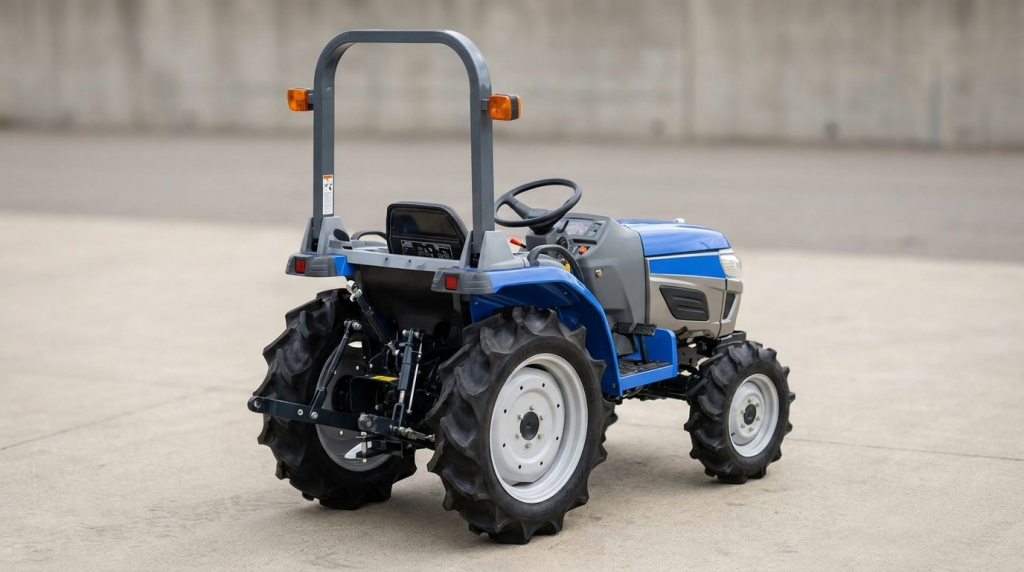
All models have a 3-point JIS 0-type coupling with position control (ポジションコントロール) as the basic control method. Important to know: Iseki does not publish a numerical lift capacity in kg for this series — this figure is missing from both the specifications chapter and the hydraulics operation chapter of the manual. So when buying a used unit, don't rely on lift capacity figures you may come across online for "TH-series" tractors; these are often taken from a different, unrelated Iseki export series (TH4000/5000) with a different, larger lift mechanism.
The lowering speed of the lift is adjusted via a hydraulic lowering speed knob: counterclockwise for faster lowering (light implements), clockwise for slower (heavy implements), and turning it fully clockwise locks the lift completely. The electronic Q version also has automatic plow depth control and automatic leveling control with a tilt sensor.
PTO: three settings, plus reversible
| Setting | Application |
|---|---|
| 1 (low) | Coarse breaking work |
| 2 (medium) | Normal plowing/tilling |
| 3 (high) | Fine work, for example puddling rice paddies — not available on the S25 semi-track version |
There is also a reversible PTO setting (逆転PTO) for clearing soil in corners, with the same 3 settings at a slightly lower speed — also not available on the S25 version. The PTO shaft is the same across all models: 6-splines, Ø35 mm.
Track width adjustment
The front track width is fixed per model (830-980 mm, depending on model/version) and is not adjustable. The rear track width, however, is adjustable, with a factory setting and range that varies per model — see our article with the technical specifications for the exact values per model.
What can you realistically do with 18.5 to 26.5 hp?
A common mistake is confusing PTO power with engine power or pulling power. For this series, Iseki does not publish a separate PTO horsepower figure, so use the engine power as an upper limit and take drivetrain losses into account. In practice, this means:
- TH185/TH205 (18.5-20 hp): fine for a light rotary tiller up to about 1.2 m, a small rotary mower, a front loader for light earthmoving work, or transport with a single-axle trailer.
- TH215/TH235 (21.5-23.5 hp): a medium-duty tiller, a one- to two-furrow plow in light soil, or a flail mower.
- TH255/TH265 (25-26.5 hp): the top end of this series — suitable for a two-furrow plow in normal soil, a wider tiller, or heavier transport jobs. With intensive front loader use, it's wise to keep an eye on the front axle (see our article on troubleshooting).
When choosing implements, always pay attention to the weight of the implement relative to the tractor's weight (see our specifications table) — an overly heavy front implement on a light TH185/205 will compromise steering behavior and stability.