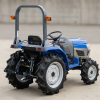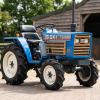




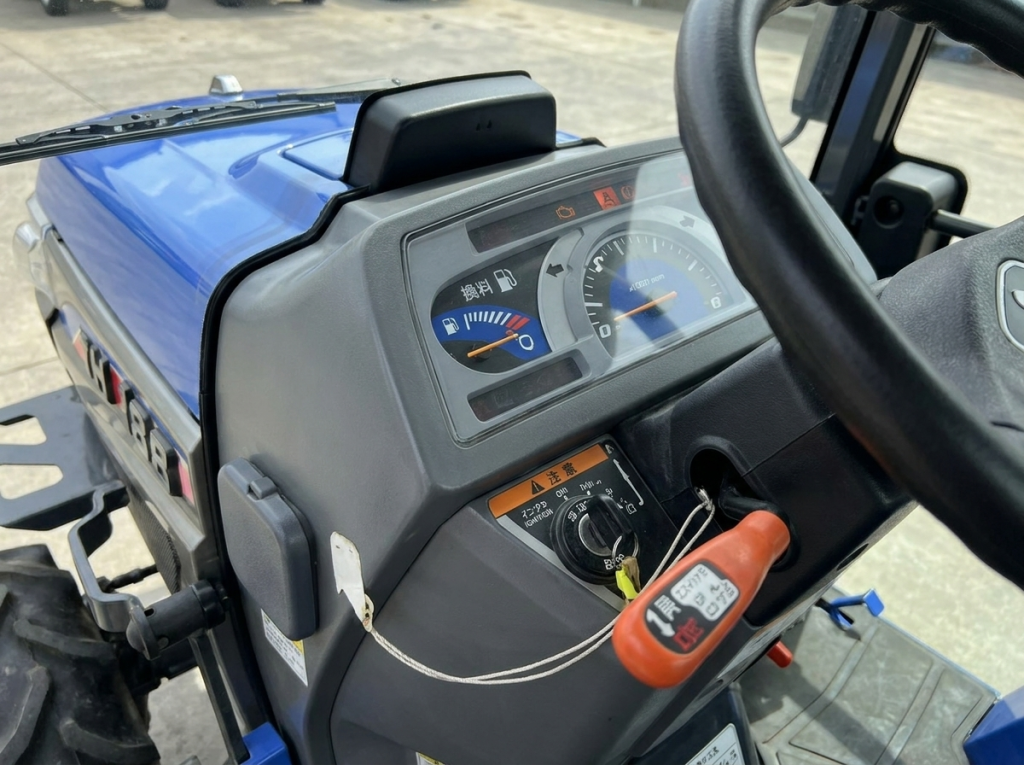
Troubleshooting the Iseki TH185-TH265
Suitable for the entire series: Iseki TH185, TH205, TH215, TH235, TH255, and TH265. The Iseki factory manual includes an extensive troubleshooting table (engine, transmission/hydraulics, electrical, cabin). We've also added known weak points from the broader Iseki compact tractor family from the same production period — clearly marked, since not everything has been confirmed 1-to-1 for these exact model numbers.
Engine won't start or starts with difficulty
From the manual: in case of starting problems, check in order: battery voltage/terminals, fuel level and supply, and whether the clutch pedal is fully depressed (a safety switch blocks starting if it isn't).
From experience with the broader Iseki family (not exclusively confirmed for these model numbers, but a recognizable pattern): extremely slow cranking at temperatures around freezing point often indicates a JDM battery with insufficient cold cranking amps (CCA) combined with winter oil that's too thick. Solution: a battery with higher CCA, 0W30 oil in winter, and heavier battery cables. A poor ground connection between the battery and starter motor — despite new parts — is also a known, easily overlooked cause; check the ground cable.
Power loss or air in the fuel system
After running out of fuel, replacing a filter, or a long period of inactivity, air can get into the fuel system. Standard procedure: open the bleed valve/screw on the filter housing until fuel comes out bubble-free, and if necessary, loosen the injector lines at the injectors and crank the starter to clear them. Diagnostic sequence for fuel-related complaints: check lines/hoses → fuel filter and drain cock → lift pump → injection pump as a last resort.
Hydraulics: lift is slow or sinks under load
Does the lift sink faster as more weight is applied? That points to cylinder or piston leakage. Does the lift fail to rise, or are the lift arms powerless? Then consider a stuck relief valve, a closed throttle valve, air in the system, or a worn pump. Contaminated or milky transmission/hydraulic oil with metal particles in the filter often indicates a worn PTO clutch — see our article on engine oil & fluids for the reason this is a shared circuit in this series.
Clutch
Slipping under load usually indicates excessive pedal play or worn friction material — first check the pedal play (20-30 mm, see our maintenance article) before proceeding with disassembly. In case of severe wear, the tractor must be split to replace the clutch plate, pressure plate, and possibly the flywheel. Note: on related Iseki models, the number of splines on the clutch shaft varies (13 or 18) — always check this before ordering parts.
Front axle
With intensive use of a front loader, the front axle bearing design is a known point of attention in this power segment (25-40 hp) across multiple brands — relatively rare, but worth watching for with heavy/structural front loader use. A clunking noise or pulling while steering often indicates tie rod end or king pin wear.
Electrical
A battery that drains while the dynamo/alternator seems fine: on related models, this is more often a wiring issue than a faulty dynamo — the positive terminals of the dynamo and battery often connect at the starter motor, and a dirty or loose connection there can give a false "dynamo faulty" impression. Check the connections first before replacing the dynamo.
Important disclaimer
The practical points above (other than the procedures taken directly from the manual) are based on experiences with the broader Iseki compact tractor family from the same production period and architecture — not all confirmed 1-to-1 for the exact TH185-265. Use them as a good starting point when searching for the cause, not as absolute fact.
Often related to failures caused by contaminated parts: Engine oil filter Iseki TM | TH | SXG | SF (SKU-002/6) and Hydraulic filter Iseki SIAL | GEAS | TK | TG | TH | TF (SKU-250012).