



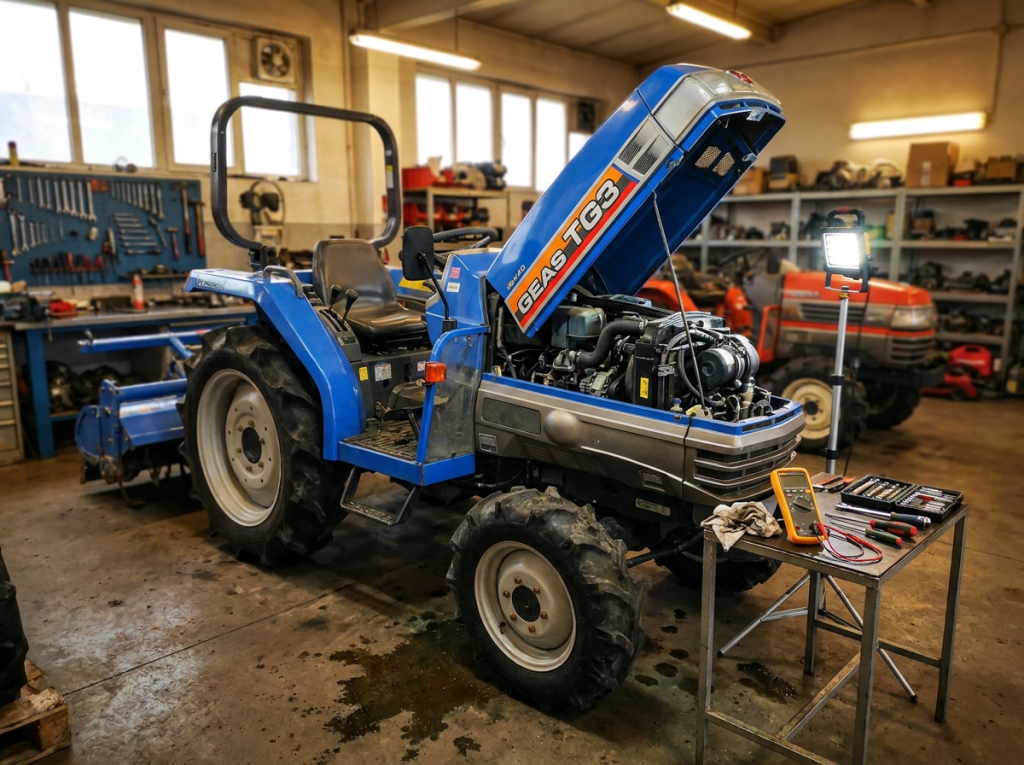
Iseki GEAS TG21-TG33 Troubleshooting and Faults
Starting problems, exhaust smoke color, front axle leakage: the Iseki GEAS TG21-TG33 is a robust series, but after decades in the field, a number of recurring faults tend to show up. Below are the most important ones, with cause and solution.
Suitable for the entire series: TG21, TG23, TG25 (+TG25N), TG27, TG29 (+TG29F-16), TG31 and TG33.
Starter motor does not turn
First check whether the clutch pedal is fully depressed — without this, the safety switch blocks the starter motor. Other causes: a discharged battery, loose or corroded battery terminals, or a faulty start switch/starter motor.
Starter motor turns, engine does not start
Usually air in the fuel system (bleed it), a clogged fuel filter, a closed fuel tap, or a deeper engine issue that requires a workshop visit.
White exhaust smoke
Usually indicates a clogged air filter (clean or replace the element) or too much engine oil (drain to the correct level). If the problem persists, the fuel supply may be insufficient — this requires a workshop check.
Black exhaust smoke
Black smoke is the most commonly reported complaint for this engine family (E3CE/E3CF/E3CD), both in factory documentation and in the practical experience of other owners. Causes are usually: poor or incorrect fuel (refill with the correct diesel), excessive fuel delivery due to an incorrectly adjusted injection pump, or too low atomizer pressure. During a cold start in winter, a temporary smoke plume is normal, but persistent black smoke under load indicates an adjustment issue that is best assessed by a workshop.
Insufficient power
Consider a stuck, clogged, or carbonized injector, low compression due to leaking valves, incorrect valve clearance, incorrect injection timing, fuel shortage, or a clogged air filter. Go through these points systematically before looking at a bigger repair.
Front axle leakage (known practical issue)
Owners of this GEAS TG series regularly report oil leakage at the front axle, caused by a worn front axle seal. This has become a well-known enough issue that a specific replacement part exists for it. Replace the seal as soon as you notice leakage or a dropping oil level in the front axle — continuing to drive with a leaking seal accelerates bearing wear.
Cylinder head and head gasket (E3C engine family, commonly known)
Within the broader E3C engine family (which includes the engines of this series), a cracked cylinder head or a blown head gasket is more frequently reported in practice, particularly after prolonged use with a too-low coolant level or a neglected cooling system. Therefore, always keep a close eye on the coolant level and use antifreeze instead of plain water during frost (see the blog on engine oil and fluids). If a head gasket leak is suspected (white/milky oil film on the dipstick, or coolant loss without visible leakage), it is wise to have it checked by a workshop — the tightening torques for the cylinder head bolts can be found in the maintenance schedule blog for this series.
Oil pressure warning light stays on while driving
First check the engine oil level and whether you are using the correct viscosity (oil that is too thin may not build up sufficient pressure). Other causes: a faulty pressure switch, a faulty oil pump, or a clogged filter element.
Charge warning light stays on while driving
First check the fuse (slow-blow, 40A main circuit or 60A alternator circuit near the radiator) and the fan belt (loose or broken also causes a charging fault). If the problem persists, the alternator or regulator may be faulty, or the battery may be low on battery water.
Clutch slips or does not disengage
Slipping usually indicates incorrect pedal adjustment or a worn/burnt clutch plate. If the clutch fails to disengage, the plate may have rusted stuck (often after long-term storage without using the clutch release arm), or the pedal clearance is incorrectly adjusted.