




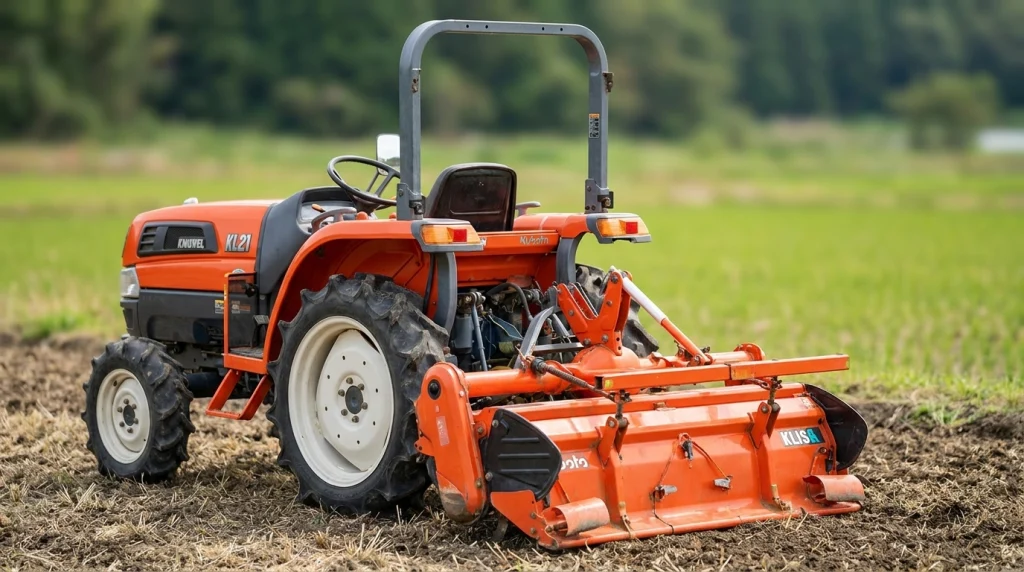
Kubota KL hydraulics, PTO and implements: what can you do with them?
The lift mechanism and PTO are what truly turn a tractor into a workhorse. The Kubota KL series was way ahead of its time in this respect, with automatic levelling and working depth control. In this article: how the hydraulics work, which PTO speeds you have, and what implements you can realistically run per model.
Suitable for the entire KL series: KL21, KL23, KL25, KL27, KL30, KL33, KL36, KL43 and the H variants KL28H, KL31H, KL34H, KL38H, KL41H, KL46H and KL50H.
Kubota KL three-point linkage and position control
All KLs have a three-point linkage according to JIS type 1 (comparable to cat. 1) with position control: the position of the hydraulic lever determines the exact lift height, so an implement always returns to the same height. The height limitation knob lets you set the maximum lift height, for example to prevent a rotary tiller from hitting the mudguards. When the lift is hydraulically locked, the implement won't lower — push the lever forward and unlock first if the lift "doesn't respond".
Kubota KL Monroe-matic and automatic depth control
The Monroe-matic automatically keeps the implement level, regardless of whether a rear wheel drives through a dip — essential for tillers and seedbed preparation on uneven ground. An angle sensor measures the tilt and a separate cylinder continuously corrects the right lift rod. In addition, the MA/MAD versions automatically control the working depth and raise the implement independently when reversing (backup) or at the push of a button (auto-up and the Pompa lift automatic). If a function doesn't work, the LCD screen points to the relevant sensor with a text message; in many cases an oxidised connector is the real culprit.
Kubota KL PTO: four speeds plus reverse
The rear PTO (JIS 35 mm, 6-spline) has four speeds and a reverse setting. In gear 1, at nominal engine speed it turns at approximately 540 to 565 rpm — matching standard 540 implements. The higher gears (around 760–795, 945–985 and 1260–1315 rpm) are intended for Japanese implements with a high drive speed; do not use them with a European 540 rotary tiller, as it would then spin far too fast. The reverse setting turns the PTO backwards, for example to free a jammed tiller.
Kubota KL: what can you do with how many hp?
The stated power is engine power; at the PTO you retain approximately 85 to 90 percent, and pulling power is mainly determined by weight and tyres. In practice this means: a KL21 to KL27 comfortably runs a rotary tiller or flail mower of 1.2 to 1.4 metres and pulls a single-furrow plough. The KL30 to KL36 handles a tiller of 1.4 to 1.7 metres, a two-furrow plough or a medium-weight bale trailer. The KL43 and the larger H models run implements up to approximately 1.8 to 2 metres and, thanks to their weight of over 1500 kg, are also serious tractors for transport work. When doing heavy lifting work, fit front weights: the factory delivers the KLs with relatively light front axles, and the power steering masks a front end that's too light.
Kubota KL four-wheel drive and dual-speed turn
You engage 4WD with a lever; the dashboard shows whether 2WD or 4WD is active. The AD dual-speed turn makes the front axle turn faster when the front wheels are steered, allowing the tractor to make an extremely tight turn on the headland without disturbing the ground. Wear in the front axle drive coupling is noticeable as clicking or play noises when engaging 4WD.
Tip from Shop4trac: play in the drivetrain to the front axle? The coupling piece for the 4WD axle (SKU-71001) is explicitly suitable for the KL series and available for immediate delivery. For slow-responding hydraulics: start with fresh transmission/hydraulic oil and a new hydraulic filter (SKU-250006).