



Kubota B7001 implements: what can you do with 14 hp?
The Kubota B7001 owes its versatility to the three-point linkage and the power take-off (PTO). With these, you can attach a rotary tiller, mower, flail mower, or transport box. In this article, you'll learn how the hydraulics and PTO of the B7001 work, what adjustment and setting options the lift offers, and — in detail — which implements suit this 14 hp tractor and what you can realistically do with them.
Suitable for the entire series: Kubota B7001, B7001E, B7001DT, B6001 and Zen-Noh ZB7001 / ZB6001.
The three-point linkage
The B7001 has a three-point linkage with position control: you set the lift lever to a position and the implement follows that height. The lift is powered by the transmission/hydraulic oil from the transmission case (11.5 liters of UTTO oil). If the lift works slowly or erratically, contaminated or old oil is the most common cause — as is a clogged hydraulic oil filter (clean this every 50 hours).
Many B7001s were delivered from the factory without a top link mount. If you want to connect an implement with a top link, you'll need a top link bracket.
Adjustable lift functions
The manual describes several adjustments that let you tailor the lift to your task. Good to know, as they make the difference between neat tilling and bumpy work:
- Setting the drop speed. You can control how fast the implement lowers. For heavier implements, set the drop to a slower speed so the tool enters the ground calmly and in a controlled manner.
- Limiting the lift range (up and down). The maximum lift and drop range can be adjusted, giving you a repeatable working height and preventing the implement from going too high or too low.
- Adjustable rear wheel width. The rear track is adjustable, so you can set the tractor wider or narrower — handy for keeping the wheel tracks alongside your tilling pass or for extra stability.
The power take-off (PTO)
| PTO specification | Value |
|---|---|
| Output | Rear (plus mid-/front PTO for tiller) |
| Rotation direction | Clockwise (viewed from the rear) |
| Speed settings | 2 settings |
| Height above the ground | 490 mm |
| PTO power | ± 13 hp (indicative, external source) |
The B7001 uses a tiller mounted underneath the tractor, driven via its own PTO shaft — a typical setup for these Japanese compact tractors. Always disconnect an implement with the engine off and the PTO disengaged, and keep your hands away from the driveshaft while the engine is running.
What can you do with 14 hp? Power in perspective
The B7001 delivers approximately 14 hp at the engine and around 13 hp at the PTO, with an empty weight of about 475 kg (4WD). That sounds modest, but for a light tractor it's important to distinguish between two types of power:
- PTO power determines how much a powered implement (tiller, mower, flail mower) can handle. Here the B7001 is stronger than you'd expect based on its weight — for tilling and mowing, this is the power that matters most, not pulling power.
- Pulling power determines what you can tow (plow, cultivator, cart). This is limited by the low weight and traction. On heavy, wet soil, that's the limiting factor — and that's exactly where the 4WD version (B7001DT) makes a difference.
Rule of thumb: the B7001 excels at light to medium-duty gardening, yard, and hobby jobs on plots up to a few thousand square meters. It's not built for large-scale plowing or heavy tillage — that's where weight and grip become limiting factors.
Which implements fit the B7001 — and what can you do with them?
Below, per implement, is what's realistic with this 14 hp class:
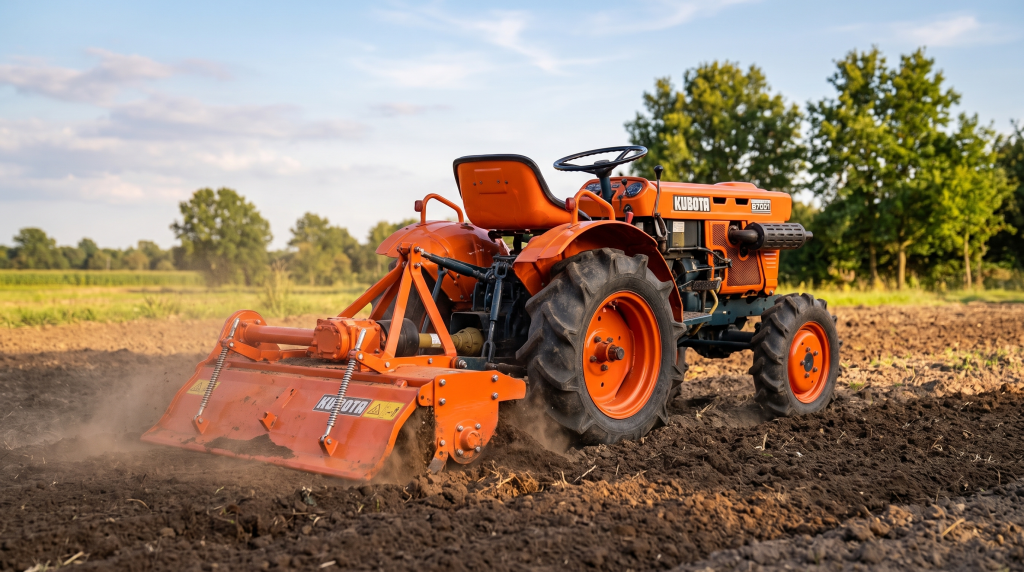
- Rotary tiller (90–115 cm): the showcase job for the B7001. A tiller requires PTO power, not pulling power, so this is an excellent match. Ideal for preparing a vegetable garden or flower bed, loosening a compacted paddock, or working in a green manure crop. On heavy clay, choose a slightly narrower tiller or work in a lower gear.
- Flail mower / sickle bar mower (up to ± 1.2 m): great for rough grass, verges, ditch banks, and tall weeds. Keep the working width modest so the PTO can maintain its speed in heavy vegetation.
- Cultivator / hiller: light soil work and row cropping (hilling potatoes, hoeing weeds between rows). Good work for a light tractor.
- Plow: stick to a single-furrow (reversible) plow on light to medium soil. A wide multi-furrow plow is too demanding in terms of pulling power and weight.
- Transport box / trailer: handy for hauling soil, wood, manure, or tools around the yard. Don't overload the lift, and keep the load low for stability.
- Front loader: only for light material (loose grit, leaves, light bales). Pay close attention to axle load distribution and use rear ballast — an overloaded loader makes such a light tractor unstable.
- Seasonal work: snow blade or snow blower, sweeper, earth auger, and leaf blower/vacuum are all workable within the 14 hp class.
Choose implements whose working width matches the power available: a narrower implement that maintains its speed is preferable to a wide one that bogs down the engine. That way you work comfortably and spare the drivetrain.
2WD or 4WD for implements?
For powered implements (tiller, mower), the 2WD B7001E is perfectly adequate — here PTO power is what mainly counts. If you're going to tow on heavy or wet soil, with a plow or a loaded cart, the 4WD version (B7001DT) offers noticeably more grip and will pull through where the 2WD slips.
Working safely with front or rear weight
If you mount a front loader or heavy rear implement, pay attention to axle load distribution. An overloaded front axle, or a tractor made light at the front by a rear implement, is dangerous. Use ballast where needed and keep everything balanced. When tilling, don't set the speed higher than necessary, and let the tiller sink into the ground gently using the drop speed setting.