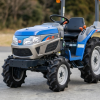




Iseki TU165 buying advice: the Landhope generation explained briefly
Iseki TU165 buying advice: the Landhope generation explained briefly
Looking for an Iseki TU165 or one of its siblings from the Landhope series? Then you're buying one of the most widespread Japanese mini tractors of its time: compact, sturdily built, and with a diesel engine that can take a beating. In this article, you'll learn what to look out for before buying a used one, how the models differ from each other, and what you can realistically expect price-wise.
Suitable for the entire series: Iseki Landhope TU145, TU155, TU165, and TU175 (2WD and 4WD versions).
Iseki TU145/155/165/175: one generation, four power classes
The TU145, TU155, TU165, and TU175 are essentially the same tractor in four power sizes. The same chassis, the same steering, the same transmission with 6 forward and 2 reverse gears, and the same controls — only the engine and a number of dimensions differ. This makes the choice relatively simple: you mainly choose based on the power you need and the budget you have.
| Model | Power | Engine code | Weight (2WD) | Versions |
|---|---|---|---|---|
| Iseki TU145 | 14.5 hp / 2500 rpm | K3B (849cc) | 610 kg | 2WD and 4WD (TU145F, TU145F-13) |
| Iseki TU155 | 15.5 hp / 2500 rpm | K3C (900cc) | 625 kg | 2WD and 4WD (TU155F, TU155F-N17, TU155MF) |
| Iseki TU165 | 16.5 hp / 2500 rpm | K3D (979cc) | 660 kg | 2WD and 4WD (TU165F) |
| Iseki TU175 | 17.5 hp / 2500 rpm | K3D (979cc) | 665 kg | 2WD and 4WD (TU175F, TU175MF) |
Note: the TU145 and TU155 have a different, smaller engine (K3B and K3C respectively) than the TU165 and TU175, which both have the larger K3D engine with 979cc. This isn't just a matter of horsepower — it also means that engine-specific parts such as the head gasket and piston rings are not interchangeable between these two groups. More on that in our Iseki TU165 specifications blog.
Iseki TU165 and the sister series TU147/157/167/177
If you start searching for parts or comparable tractors, you're almost guaranteed to come across the models TU147, TU157, TU167, and TU177. This is not a typo, nor is it a different tractor: the original Iseki factory manuals for both series show that the technical specifications — engine code, displacement, power, dimensions, weight, tires, transmission, capacities, even the troubleshooting table — are literally identical on every point between the TU145/155/165/175 series and the TU147/157/167/177 series.
In practice, this concerns two parallel model number series for the same generation of tractor, presumably differing by production year, export market, or dealer badge. Parts between, for example, a TU165 and a TU167 are therefore almost always interchangeable one-to-one, simply because they involve the same engine (K3D) and the same chassis. So if you see a TU167 in a listing while you're looking for a TU165? Technically, that makes hardly any difference.
Don't confuse this with the real difference that does exist within the series itself: TU145/TU155 with the smaller K3B/K3C engine versus TU165/TU175 with the larger K3D engine. That difference is indeed relevant for engine parts.
Iseki TU165: what is this tractor suitable for?
With 14.5 to 17.5 hp, this generation falls into the segment for light groundwork, hobby farming, and landscaping businesses. Think of mowing grassland, small-scale tilling, moving a trailer, snow clearing with a blade, or light transport on a yard or vegetable garden. This tractor is not built for heavy earthmoving or large areas — the power is simply too limited for that — but for the average private user or small business owner, it's a great workhorse, partly thanks to the wide availability of 3-point implements with 2-point (2P) attachment.
Iseki TU145/155/165/175 used prices (indicative)
The price of a used Iseki from this series depends heavily on the number of operating hours, the version (2WD or 4WD), whether power steering or a cabin is present, and the general maintenance condition. The amounts below are therefore indicative and intended as a guideline, not a fixed price.
| Model | Power | Indicative price range |
|---|---|---|
| Iseki TU145 | 14.5 hp | €2,000 – €3,500 |
| Iseki TU155 | 15.5 hp | €2,500 – €4,000 |
| Iseki TU165 | 16.5 hp | €3,000 – €6,000 |
| Iseki TU175 | 17.5 hp | €3,500 – €6,500 |
As an indication: a TU165 with around 750 operating hours is often offered in practice for around €5,150 to €6,232 including VAT, while units with more operating hours or a bare 4WD version without extras tend to go for closer to €4,000. A TU175 excluding VAT is often offered between €3,750 and €4,450. In any case, don't let yourself be guided by the model number alone — physically assess each unit and always take a test drive.
Buying an Iseki TU165: what should you look out for?
Before signing anything, it's best to go through the points below.
Check the engine code on the type plate. Since the TU145/TU155 and TU165/TU175 have different engines (K3B/K3C versus K3D), it's important to know which engine is actually installed — especially if you're looking for parts or aren't entirely sure of the model in the listing. The type plate and the engine code on the engine block will give you certainty.
Pay attention to the exhaust fumes during the test run. Noticeably heavy white smoke at idle that decreases when accelerating is a known point of attention with these older diesel engines and can indicate worn injectors, incorrect injection timing, or low compression. Black smoke is more likely to point to fuel quality or excessive load. Read more about this in our Iseki TU165 faults blog, where we cover this extensively.
Check the clutch, brake, and steering play. Press the clutch and the brake and feel whether the play still falls within the normal margin (clutch pedal 20-30mm, brake pedal 30-40mm). A slipping clutch or one that doesn't engage properly, and brakes that pull to one side, are often easy to fix but are still a negotiating point.
Check for rust near the chassis and the chassis number. These tractors are often already several decades old. Check the frame, the rear axle, and the location of the chassis number for corrosion, previous weld repairs, and leaks around the engine and transmission.
Ask about the maintenance history. Has the oil been changed regularly, have filters been replaced, has the coolant been kept topped up? A tractor with a well-maintained history is often a better purchase than a slightly cheaper unit with no history at all.
Want to look ahead to maintenance after purchase? Check out our complete filter set Iseki TU Landhope (oil filter, fuel filter, air filter, and drain plug gasket) for €28.50 — handy for doing a service right after purchase, regardless of which model in the series you've bought.