



Iseki SIAL TF15, TF17 and TF19 Seasonal Maintenance — From Winter Storage to Spring Start-up
Iseki SIAL TF15, TF17 and TF19 Seasonal Maintenance — From Winter Storage to Spring Start-up
Every season demands something different from your tractor. Complete checklists for storage, spring service, summer, and wet work.
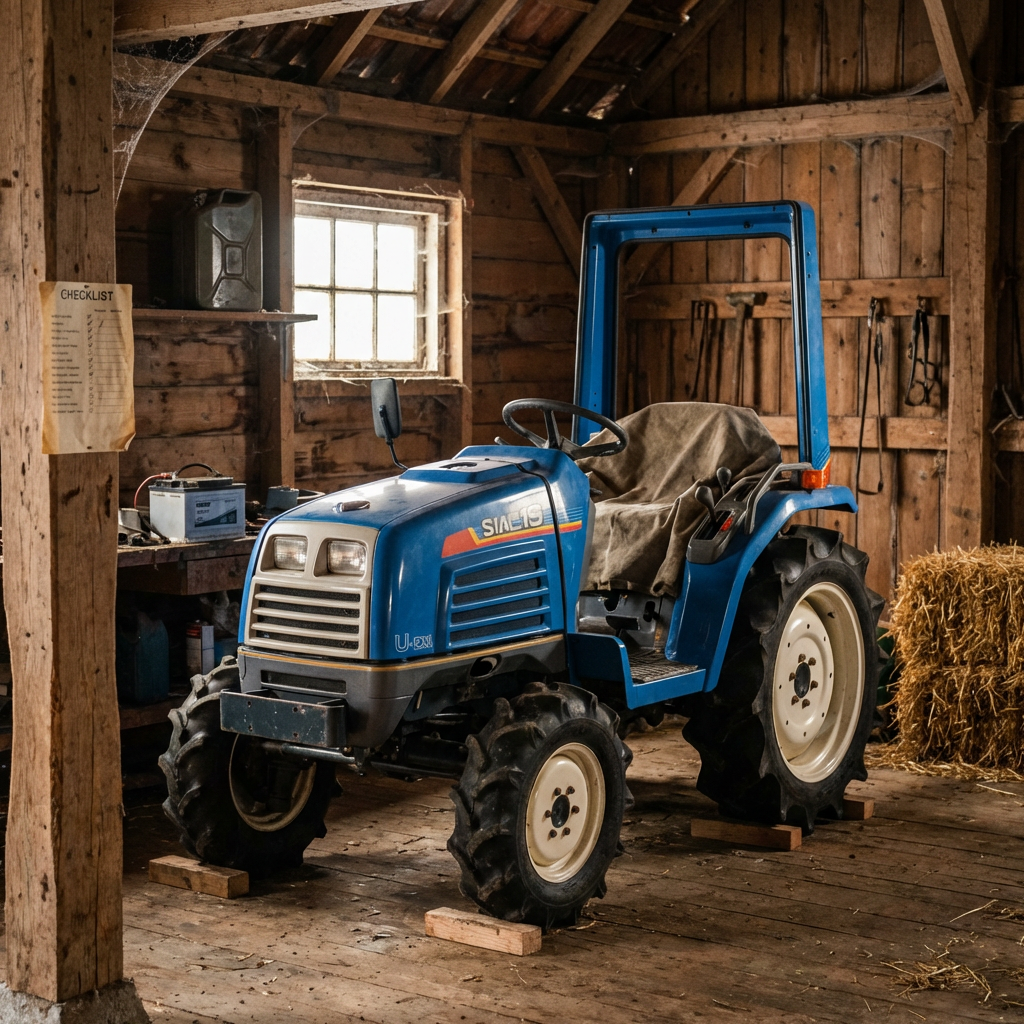
Your SIAL isn't working equally hard all year round. In winter it often sits idle for months, in spring you suddenly need it every day, and in summer it has to perform in high temperatures. Each season has its own points of attention — and if you ignore them, you'll notice it sooner or later in the workshop. In this blog, you'll find a practical checklist for each season: what needs to be done in autumn (winterizing), in spring (starting up), in summer, and during wet work. All according to the Iseki manual, supplemented with practical experience from SIAL owners.
Winterizing — the autumn check
Not going to use the SIAL for more than a month? Then a good storage protocol isn't a luxury but a necessity. Two nasty enemies come to visit during a winter in the shed: moisture and slow wear from inactivity. With the right preparation, you can keep both at bay.
Go through the 12 points below calmly — expect about half a day's work for thorough winter storage.
- Cleaning. Wash the tractor thoroughly with water and, if needed, a mild cleaning agent, especially after working in mud or on wet ground. Leftover mud retains moisture for months and is the fastest route to rust formation under the mudguards and around the axle passages.
- Fill the fuel tank completely. A full tank prevents condensation from forming on the inside. The mechanism is simple but deceptive: during the day the air in a half-empty tank warms up and expands, at night it cools down and draws in humid outside air — which condenses against the cold tank wall. Every temperature cycle produces a bit of water. After a few months you have a layer of water at the bottom, right where the fuel line is. A full tank has almost no air, so almost no condensation. Is your storage period longer than about 6 months? Then it's wise to drain a small amount of diesel via the fuel tap in spring, collect it in a glass jar, and check for water (which sinks to the bottom) or a sour smell (= aging). If in doubt, simply refresh it.
- Disconnect, lower and store implements. Remove the mower, flail mower, or other implement. Do you have an implement you can't disconnect? Then at least make sure to lower it all the way to the ground so that the lift cylinder and hydraulic hoses aren't under pressure for months. Grease the 3-point pins with a thin layer of grease before storing them. Clean and grease the implement itself too — especially with mowers, where plant material would otherwise compost between the blades.
- Store indoors or cover. Dry and covered is ideal. Is the tractor forced to stay outside? Then use a breathable tractor cover — a plastic tarp actually traps moisture and only makes things worse.
- Change engine oil. Fresh oil before winter, not after. Old oil contains acid residues and combustion residues that attack pistons and cylinder walls during months of inactivity. After changing, run the engine at idle for 5 minutes to circulate the new oil everywhere. The SIAL needs 3.1 liters of engine oil (see also the maintenance schedule).
- Check coolant. At temperatures below 0°C there must be sufficient antifreeze in the cooling system. Insufficient antifreeze = a cracked engine block at the first severe frost, and that's a total-loss scenario. Haven't checked the antifreeze? Then drain the coolant completely and hang a clear "EMPTY — NO WATER" sign on the steering wheel. Never start with an empty cooling system. The SIAL takes 5.0 liters of coolant.
- Take care of the battery. This is where most tractor owners go wrong. A battery that does nothing all winter is practically dead by March — and many glow plug issues in spring start here. Three options:
- Remove the battery and store it indoors — preferably in an attic or a frost-free space. Recharge it monthly with a trickle charger.
- Connect a trickle charger while the battery stays in the tractor. Maintenance chargers (3–5 watts) use almost no power and keep the battery in good condition.
- At minimum, disconnect the negative terminal if you can't do anything else. This prevents parasitic drain and short circuits caused by rodents. In that case, recharge the battery every 2 months in between.
SIAL owners on Dutch forums warn: a battery that gets too discharged in freezing temperatures sulfates permanently — then all you can do is buy a new one. And don't forget: a "good" battery is essential for a smooth start of a diesel engine with glow plugs. The starting current a SIAL needs to turn over properly requires a healthy battery, otherwise your spring start-up will be an hour of glowing and cranking.
- Inflate tires slightly higher. About 0.2 bar above normal pressure. This prevents the tires from developing flat spots in one place during prolonged inactivity — otherwise you'd feel that as an uneven ride well into the following season.
- Disengage the clutch (clutch cutoff). Use the clutch cutoff arm to lock the clutch in the disengaged position. This prevents the clutch plate from rusting to the flywheel — a classic problem for tractors that have spent a wet winter outside. Loosening it in March is then difficult (and costly).
- Grease all lubrication points. Fresh grease protects against moisture ingress at the clutch and brake pedal hinges, and at the front axle hinges. Give all grease nipples a generous dose. Grease is cheaper than repairs.
- Check bolts and nuts. Especially wheel nuts, 3-point attachments, and the hood mounting. Go through everything and tighten any bolts that have vibrated loose to the correct torque. Loose bolts will only vibrate further loose during the season — start fresh.
- Place wheel chocks. Place chocks in front of and behind at least one wheel. The SIAL's parking brake works mechanically, but after months of inactivity moisture may have gotten into the brake components and it may grip less effectively. Don't rely solely on the parking brake for long-term storage.
Starting up after winter storage — the spring check
March or April. The days are getting longer, the grass is growing again, the implements need to go on. But before you turn the key: take an hour to carefully bring the SIAL back into service. That prevents your first day of work from ending in the workshop.
Step 1: All-round inspection
Walk around the tractor twice. What are you looking for? Puddles of oil or coolant on the floor, chewed hoses or cables (mouse damage!), bird nests under the hood, rust spots that weren't there before winter. Anything that looks different from when you put it away deserves attention.
Step 2: Check fluids
This is the moment when condensation shows its face. Check systematically:
- Engine oil — pull the dipstick. Does the oil look milky brown ("mayo effect")? Then condensation has mixed oil and water. Change it immediately before starting. Also check under the oil filler cap — a white-brownish foam there is the same signal.
- Transmission/hydraulics — dipstick under the seat. Same test: clear = okay, milky = change.
- Front axle oil — level plug. Water can enter via the seals.
- Power steering fluid — check the reservoir, top up to level.
- Coolant — check level, assess color. Cloudy or rust-brown? Replace.
- Fuel — drain a small amount of diesel via the fuel tap into a glass jar. Water sinks to the bottom (clearly visible as two layers), and old diesel smells sour instead of diesel-fresh. Both are reasons to replace the diesel and filter before starting.
Step 3: Connect the battery
Positive terminal first, then negative. This is the correct order to prevent sparking. First check the fluid level in the battery cells (for a wet battery) and top up with distilled water if needed. Use a multimeter to check that the battery delivers at least 12.4 V — below that you'll almost certainly have a poor start.
Step 4: Check fuel filter and air filter
The fuel filter is a classic suspect after a winter of inactivity. Even with a full tank, some condensation or rust may have gotten through. ★ Replacing is always safer than hoping. The complete filter set TF17-TF23 (€32.50) contains all three filters for an annual spring service.
Also tap out or replace the air filter. Mice love nesting material from air filters — you wouldn't be the first to find a mouse colony under the cover.
Step 5: Tire pressure and clutch
Return tire pressure to the normal value (see specifications for exact values per tire size). Release the clutch cutoff arm so the clutch works normally again.
Step 6: Starting — with patience
Follow the normal starting procedure. In cold weather in March, proper pre-glowing is essential — expect about 20 seconds of glowing at outside temperatures around 5°C, and up to 30 seconds in freezing conditions. That's the experience you'll find on virtually every Dutch tractor forum for Iseki mini tractors: better to glow 10 seconds too long than too short. A long-stroke diesel wants its combustion chamber warmed up before it fires.
Step 7: Warming up — 30 minutes, no shortcut
Once it starts, let it idle and warm up for at least 30 minutes. In cold spring weather (below 5°C), rather 20–30 minutes; in slightly warmer weather, 15–20 minutes. This seems long, but after months of inactivity the oil sits thick and viscous at every lubrication point. Revving up immediately with cold, thick oil is the fastest route to bearing damage and worn piston rings.
Step 8: Function test
Before you get to work: test all functions on the yard first, in a quiet environment:
- Both brake pedals separately — do they grip evenly?
- Clutch — smooth or jerky?
- All gears forward and reverse
- Engage and test 4WD
- Hydraulics — raise and lower the lift fully several times (this also bleeds the system)
- PTO — engage briefly without an implement, listen for odd noises
- All lighting — headlights, taillights, turn signals
- Horn
Summer — preventing overheating
Hot summers are increasingly becoming a reality in the Netherlands and Belgium. For a SIAL with a compact cooling system (5 liters), that means extra attention is needed, especially during heavy work like flail mowing or tilling on hot days.
Keep the radiator clean. This is really the critical check. Grass, seed fluff, insects, and dust clog the radiator fins in no time, and then the tractor doesn't get enough airflow. Pull out the protective grille and rinse the radiator from the inside out — so rinse from the engine side outward, so that dirt actually comes out instead of being pushed further in.
Check coolant more often. In heat, antifreeze evaporates faster and you may see the level drop within a few weeks. Checking daily during heavy work days takes 10 seconds and prevents overheating at the worst possible moment.
Check engine oil. At high temperatures, oil becomes thinner. Check the dipstick weekly — if the oil shows signs of fatigue, simply change it a month earlier than planned. 15W-40 is the standard choice for the SIAL and works fine in Dutch summer temperatures too.
Air filter check during dusty work. Mowing dry grass and seed fluff demands an air filter in top condition. Tap out the filter weekly during intensive work, and replace it if you can no longer see light through it. Insufficient air supply = black smoke + power loss + overheating. The three symptoms often occur together.
Don't leave it idling too long in the sun. A SIAL that idles for half an hour in full sun with the hood closed heats itself up extra. If you're working on-off, just turn it off in between.
Wet conditions — autumn, early spring, wet summers
Working in mud, on a boggy meadow, or on flooded terrain requires extra care. Water washes away protective lubrication and finds its way along every seal.
Daily greasing. Normally you grease every 50 operating hours, but for wet work: after every workday top up all grease nipples. That sounds like a lot, but it's only a handful of nipples (clutch and brake pedal, front axle hinges), and it saves you hundreds of euros in front axle repairs over time.
4WD engaged. Always engage 4WD on boggy terrain. Use the differential lock (deflock) if one wheel is slipping — but switch it off again as soon as you have grip. Deflock + turning = creaking in the front axle, not good for the components. Never engage deflock on paved roads.
Rinse the tractor after use. Mud that dries in the sun becomes as hard as concrete and retains moisture in the cracks for weeks. Rinse the tractor with a garden hose after every wet workday, especially around the axle passages, the 3-point hitch, and the front axle hinges.
Check the front axle extra. Check the front axle oil level more often when working on wet terrain. Water can seep in via the seals, mixing front axle oil and water — milky front axle oil is a sign that you need to replace the seal. A stub axle seal for the SIAL costs €12.50.
Monthly test for infrequent use
Not really using the tractor for a few months — for example between October and February in a mild winter — but don't want to go through the full storage protocol either? Then do a monthly run:
- Check the battery (at least 12.4 V).
- Pre-glow, start.
- Run it for at least 10 to 15 minutes at 1500–2000 rpm (not idle — the alternator won't charge properly at idle).
- Move the lift up and down a few times.
- Briefly engage and disengage 4WD.
- Turn off, put away.
This prevents cylinder walls from rusting up and keeps the battery charged. Small effort, big difference.
Seasonal calendar — summary
| Season | Key tasks |
|---|---|
| Autumn (Oct–Nov) | Winter storage protocol (12 points), change engine oil, check antifreeze, take care of battery |
| Winter (Dec–Feb) | Recharge battery monthly (or store indoors), visual check for shed damage |
| Spring (Mar–Apr) | Spring check (8 steps), replace filter set, 30 min warm-up, function test |
| Summer (May–Aug) | Keep radiator clean, check coolant and oil more often, air filter during dusty work |
| Wet work (all seasons) | Daily greasing, 4WD, rinse after use, check front axle oil |
Ready for the season? Get your parts from Shop4trac
Filter set, glow plugs, V-belt, seals, antifreeze — everything for a complete spring service or winter storage. Fast delivery from the Netherlands, specialist in mini tractor parts.