




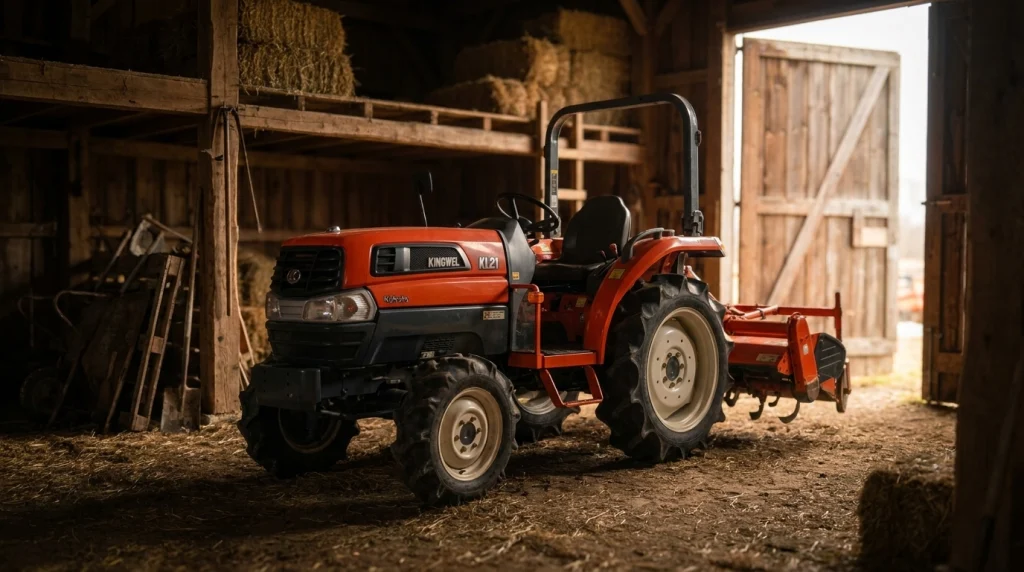
Kubota KL storage and seasonal maintenance: how to winterize your tractor properly
A lot of damage to a Kubota KL doesn't happen while it's working, but during the months it stands still. A seized clutch or a dead battery in spring can be completely prevented. These are the storage instructions from the factory manual, supplemented with practical tips for our damp winters.
Suitable for the entire KL series: KL21, KL23, KL25, KL27, KL30, KL33, KL36, KL43 and the H-variants KL28H, KL31H, KL34H, KL38H, KL41H, KL46H and KL50H.
Preparing your Kubota KL for winter: the factory procedure
Kubota prescribes a fixed routine for long-term storage. First fix any faults. Change the engine oil and then let the engine run for 10 to 15 minutes at a minimum of 2000 rpm, so the fresh oil reaches and protects all engine parts — repeat this anti-rust run every one to two months during storage. Fill the diesel tank completely to prevent condensation. Remove the wheel weights and switch off implements or lower them to the ground.
Locking the Kubota KL clutch: the most important storage detail
The most forgotten instruction: lock the clutch pedal in the depressed position using the locking bracket fitted to the pedal for that purpose. If the clutch stays pressed against the flywheel for months, the plate will seize — and a seized clutch means the tractor will drive off the moment you start it, or the clutch housing will need to be opened. Also drain the water via the drain plug at the bottom of the clutch housing and check that no moisture is present.
Kubota KL battery, tires and electronics
Remove the battery from the tractor and store it in a cool, dry, ventilated place; recharge it every one to two months. If you leave it on the tractor, at least disconnect the ground clamp — the KL's electronic dashboard has a small standby current that will drain the battery over a long winter. Inflate the tires slightly harder than normal to prevent deformation. Grease bare parts such as the lift rods and cylinder rod, lubricate all grease nipples, and treat the connector plugs of sensors and the instrument panel preventively with contact spray: moisture during storage is the main cause of the well-known "phantom faults" in spring. Only cover the tractor once the engine and exhaust have completely cooled down.
Kubota KL: seasonal check in spring
Before the first use, run through a short checklist. Check the oil level and coolant level, the V-belt tension (7 mm deflection), tire pressure and brake adjustment (15–20 mm pedal play, equal left and right within 5 mm). If winter oil (10W30) was applied in autumn, swap it back for 15W40 if needed. Start according to the normal procedure and let the engine warm up gently; then check that all automatic functions (Monroe-matic, backup, auto-up) work properly. Every two years, replacement of the coolant, radiator and fuel hoses and the power steering hoses is also due — plan this job during the storage period.
Tip from Shop4trac: turn storage into a small maintenance moment. With fresh engine oil, a new drain plug sealing ring (SKU-410054) and a spare V-belt (SKU-124018) your KL will be ready to go right away in spring.